Chaosium has now reclaimed the rights to RuneQuest and Glorantha, and we're given to understand that these combined will become their banner fantasy RPG product, while a new BRP Essentials becomes the root system for a loose constellation of BRP inspired games. This leaves the Basic Roleplaying book (BRP) as a sort of attic collection of rules, and Magic World, previously the core rulebook for the nascent BRP fantasy line, is left out in the cold.
We have plenty of time for RuneQuest as a rules set, but Glorantha is not our fantasy lozenge floating on an infinite sea. Its massive timeline, overlapping pantheons, entangled myths, and cultural melange are fascinating but too hard to buy in to, like a club whose rules are too obscure to encourage joining, especially when we're looking for a world of our own to create (which is probably a slipstream version of Middle-Earth and the world of Firetop Mountain, illustrated by Russ Nicholson). Consequently, it might be time to take a closer look at Magic World before it slips out of view.
In many ways, Magic World exhibits the strengths and weaknesses of the recent BRP era at Chaosium. Its rules are a compilation of some of the best of the BRP percentile, skill-based system: smooth and easy to pick up, especially if you're familiar with any other iteration. Character generation in particular is probably one of the easiest tasks in the BRP family: roll Characteristics, calculate secondary scores (HP, MP, damage bonus, skill category modifiers) and then add set percentiles (60% at most) to a specified number of skills. Combat, once you decode the wonky presentation, is also quick and intuitive (there are no location hit points to slow you down, and only one kind of special or critical). Overall, it's a highly playable system and probably an excellent place to get into your own version of Middle-Earth or Allansia.
On the other hand, the rules are clearly recycled from earlier systems: the Chaosium Stormbringer RPG in particular and RuneQuest III. This leaves us reading some eerily familiar passages, and tumbling over rules that don't apply, such as references to fatigue in the bestiary. Of course, there are errata, but the point is that the errata are too long. And the wider point is that the presentation suffers from this copy-and-paste approach. The BRP combat sequence, for example, has a fair few steps but they all flow fairly cleanly: declare intent, set initiative, roll, compare attack and parry/dodge, assign results. But the "Combat" chapter is unnecessarily long, and the effect is somewhat scattershot. Skimming headings, you see "Actions in a Round", then "Resolving Combat", then "Order of Actions", then "Actions", then "Resolution" and yet the next section resumes "Hand-to-Hand Combat" with "Game Procedures" – how many times are we told about actions and resolution? Compare this to the tight presentation in the BRP Quickstart, and you realize that the whole chapter should have been thoroughly adapted and revised, especially for new players.
The reused artwork, a mishmash of styles and settings, similarly does not always capture the intended feel of the game, and although the sorcery magic system is serviceable, since it's based on the spells from Stormbringer, which were themselves added on to a system mainly designed around summoning and binding Moorcockian demons, the spell selection is not particularly inspiring. To play a sorcerer, your choices revolve mainly around spells that enhance or diminish effects (such as damage, armor, or characteristics) or a number of nasty offensive magics, reflecting the chaos influence of Stormbringer magic. That's not especially a problem if you want a low-magic campaign (there are no fireballs or lightning bolts here) or to grab your spell ideas from other sources, but the book is called Magic World after all, but offers only a few interesting or engaging spells.
The sample setting, the Southern Reaches, is more like Roman Britain than medieval Europe, a former frontier where first supernatural powers ruled before retreating, and where an empire has now replaced the roaming tribes of humans and orcs. It's effectively a colonial province, and designed with plenty of built-in conflict, with the return of the shadowy, shape-shifting fay and tensions between the two ruling houses presenting the most potential for adventure. The Southern Reaches are therefore an excellent sample setting, but they sit only lightly on top of the main rules. The rules for Allegiance between Light, Shadow, and Balance, for instance, would work nicely in heroic fantasy but it's not clear how they apply in the Southern Reaches, or to the fay. It might have been better to explore how the Magic World rules could be used to run a variety of different fantasy settings with varying themes and tones, as per the excellent guidelines in the "Settings" chapter of the BRP rulebook.
Given time and more design and editing, Magic World could have been an excellent product, but it now sits uncomfortably between being the "Fantasy BRP" and a minor game due to be eclipsed by RuneQuest and Glorantha. Depending on the quality and design of the new BRP Essentials, it could remain a fine go-to game for fantasy adventure, but its chance to capture the high ground among fantasy RPGs has passed. Not a fumble by any means, but a hit, parried.
Friday, March 25, 2016

Thursday, February 18, 2016
A quick conversion - XD20 and Sword & Backpack
Not too long ago, the Tinkerage mentioned the ultra-light Sword & Backpack system. The rules of Sword & Backpack are minimal: roll a d20 and decide what's fair. But with a little tinkering, Sword & Backpack could be adapted to XD20, or my still nameless D20 adventure rules.
Here's how it goes. In Sword & Backpack you can play as either a Warrior, Rogue, or Sorcerer. These are types rather than classes, but we can all guess that the Warrior excels in combat, the Rogue in subterfuge and skill, and the Sorcerer in magic. Hence, we can map these to XD20 stats, or Fighting, Skill, and Magic.
Warrior (WAR) = TAC/Fighting
Rogue (ROG) = PSYCH/Skill
Sorcerer (SOR) = WAH/Magic
Assign the three scores (WAR, ROG, SOR), takes the best score as the character's primary role, figure out hits and what-not (possibly a simple three-strikes-and-you're-out system), and you're ready to play. Each character type will be able to do a little of what other types can: a sorcerer can engage in light swordplay, a rogue can read a magic scroll.
Once you have your characters, why not try the scenarios in the Lanternport adventure setting, because, really, nothing can beat delving into a vast, magical library guarded by traps and bookwyrms, and patrolled by eerie undead librarians.
Here's how it goes. In Sword & Backpack you can play as either a Warrior, Rogue, or Sorcerer. These are types rather than classes, but we can all guess that the Warrior excels in combat, the Rogue in subterfuge and skill, and the Sorcerer in magic. Hence, we can map these to XD20 stats, or Fighting, Skill, and Magic.
Warrior (WAR) = TAC/Fighting
Rogue (ROG) = PSYCH/Skill
Sorcerer (SOR) = WAH/Magic
Assign the three scores (WAR, ROG, SOR), takes the best score as the character's primary role, figure out hits and what-not (possibly a simple three-strikes-and-you're-out system), and you're ready to play. Each character type will be able to do a little of what other types can: a sorcerer can engage in light swordplay, a rogue can read a magic scroll.
Once you have your characters, why not try the scenarios in the Lanternport adventure setting, because, really, nothing can beat delving into a vast, magical library guarded by traps and bookwyrms, and patrolled by eerie undead librarians.
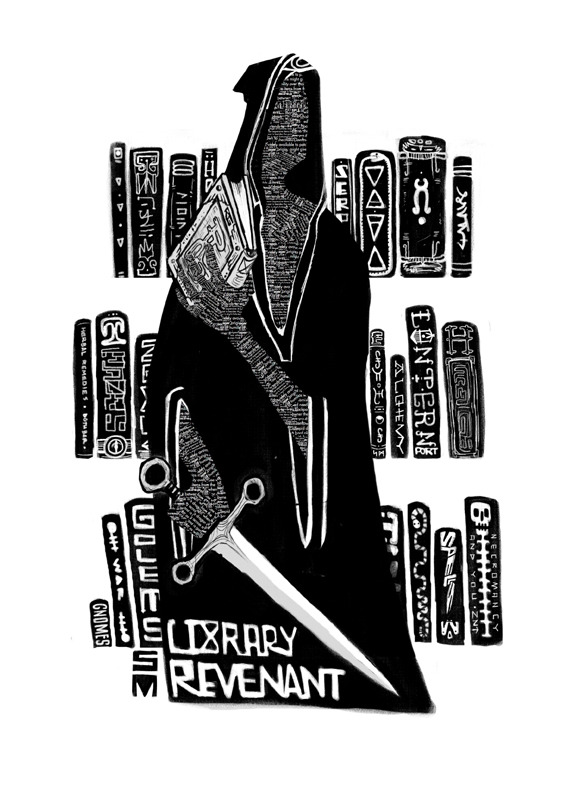 |
| Library Revenant - Art by Sam Mameli |
Sunday, February 7, 2016
A handful of skills for FF
One of the nice things about basic Fighting Fantasy is that most of what an adventurer would want to do is described in the section on common adventuring situations. There's no need for a comprehensive system of skills (as opposed to SKILL) as these situations describe what most adventurers will actually want to do in the confines of adventure: search, sneak, bribe or persuade monster, snaffle loose objects, break doors and chests.
There a plenty of skill-based systems (like BRP) with extensive lists of skills, but a few common skills could be a good way to add variety to your Fighting Fantasy character without adding much more to the rules.
Tricks & Traps: Finding the location of that hidden latch, tampering with a trap, opening a stubborn lock, detaching a tempting purse.
Persuasion: A bluff, a clever lie, or a call to a higher purpose, even striking a good bargain, all require persuasiveness.
Bind Wounds: Any form of rough healing, or first aid after battle.
Strength: Not simply training and endurance, but knowing the point of leverage, or where to exert pressure when you break open a chest or smash down a door.
Hunting & Tracking: There's always game to pursue and tracks to follow in the wild.
Wayfaring: It's useful to know the hidden paths, the landmarks, the places of safety and concealment.
Learning: Reading is one thing, but this character knows how to decipher an ancient script, the name of that demon, that crucial fragment of old lore. Speak, friend, and enter!
There a plenty of skill-based systems (like BRP) with extensive lists of skills, but a few common skills could be a good way to add variety to your Fighting Fantasy character without adding much more to the rules.
Adventuring Skills
Stealth: The first thing you want to try is sneaking past that guard.Tricks & Traps: Finding the location of that hidden latch, tampering with a trap, opening a stubborn lock, detaching a tempting purse.
Persuasion: A bluff, a clever lie, or a call to a higher purpose, even striking a good bargain, all require persuasiveness.
Bind Wounds: Any form of rough healing, or first aid after battle.
Strength: Not simply training and endurance, but knowing the point of leverage, or where to exert pressure when you break open a chest or smash down a door.
Hunting & Tracking: There's always game to pursue and tracks to follow in the wild.
Wayfaring: It's useful to know the hidden paths, the landmarks, the places of safety and concealment.
Learning: Reading is one thing, but this character knows how to decipher an ancient script, the name of that demon, that crucial fragment of old lore. Speak, friend, and enter!
How to use the skills
Skills are not just training, they're habits, strategies, approaches. In a simple FF game, offer characters three skills when they're created. Then, if the conditions are right, the skill confers a +1 or +2 bonus to action. This can be added to SKILL (or WITS, if you use that option), or even a probability roll.
Wednesday, January 13, 2016
The Darkness in the North
The Withered Lands in the north-east are where Arihmere takes a dark turn, a region of wilderness and ruins held by the deadly and enigmatic Fell Lords, servants of a usurper who many believe was slain decades ago and revived by his scheming wife. These lands are the perfect setting for a gritty, or gothic, adventure, oriented towards exploration, treasure-hunting, and avoiding (or stumbling upon) old evils. The terrain would fit the open-ended possibilities of a "West Marches" style campaign or sequence of joined adventures. One could even imagine a campaign to reclaim a ruined manor and surrounding lands, in the style of "Darkest Dungeon".
Begin with an outpost:
Then there is the terrain. Start building and detailing the campaign map, situating both perils and rare treasures among the moors, fens, overgrown pathways, and tangled woods:
As the characters uncover and meet more, you might introduce one of the Fell Lords as an antagonist or hovering threat. These are powerful characters, corrupted by their service to an undead tyrant, living an unnaturally extended life and warped by their service. Their ultimate number and identities are a matter of speculation, as are their plans and true powers, but the unique nature of each of the Fell Lords subtly informs his or her domain:
Begin with an outpost:
- A mere cross-roads, with a broken and enigmatic sign-post
- A ruined manor-house, haboring grim secrets, and with a view of the cursed fens
- An embattled city, the last to be recaptured may be the first to fall to the Fell Lords
- An outpost around a ramshackle keep
Then there is the terrain. Start building and detailing the campaign map, situating both perils and rare treasures among the moors, fens, overgrown pathways, and tangled woods:
- Tottering watchtowers, where sly grimelocks and lumbering grolls lurk. These monsters raid the borderlands and return to hide behind a multitude of crude traps.
- Deep ravines (ideal for hiding treasure), infested by wyrms and naggs.
- Spider-haunted woods, the perfect retreat for a half-mad witch.
- Battlefields, haunted by sorrowful wraiths, where every unbroken blade has a name and a story.
- And the decaying piles that once belonged to any one of the Fell Lords...
As the characters uncover and meet more, you might introduce one of the Fell Lords as an antagonist or hovering threat. These are powerful characters, corrupted by their service to an undead tyrant, living an unnaturally extended life and warped by their service. Their ultimate number and identities are a matter of speculation, as are their plans and true powers, but the unique nature of each of the Fell Lords subtly informs his or her domain:
- The Necromancer: a sorcerer on the threshold of life and death, served by wraiths and shadows
- The Sword: a fearsome warrior, and the tyrant's most hated enforcer, served by faceless armored warriors
- The Intriguer: a spy and informer, served by crows and traitors
- The Rider: the swiftest of the Fell Lords, served by spectral horses and their swift riders
- The Artificer: the smith and craftsman, served by strange mechanisms and guarded by subtle traps
- The Poisoner: a master of assassination and poisons, in his service are vipers and spiders of all kinds
- The Hunter: a stalking terror, relentless in pursuit, served by wolves and other predators, mistress of the wild places
- The Equivocator: the Fell Lords' spiritual advisor and preacher, master of guile and deception (you will never guess who your real enemy is)
- The Prowler: a withered dwarf, the Fell Lords' tax-collector, greedy and clever, offering bribes with one hand and stealing with the other, and served by treasure hunters and ghouls
Ready to explore? Then grab some rules of your own or try the nameless d20 adventure game, and set to it.
Friday, November 13, 2015
What are the BRP Essentials?
The Tinkerage has great respect for Chaosium's Basic Roleplaying, or BRP, a system that feels rules light even though it's packaged in a rules-and-options heavy compendium known as the BGB, or "Big Golden Book".
Now Chaosium has announced that BRP will become BRP Essentials, the core 32-page rulebook for a BRP family of games. But what are the essentials of a BRP system? Are they BRP itself, Runequest, in its current or past incarnations, or even one of the OGL offshoots, such as Mongoose Runequest (MRQ), Legend, or OpenQuest?
Here's a purely speculative take:
Characteristics: STR, CON, SIZ, DEX, INT, POW, CHA (or APP)... EDU perhaps? They go back a long time, the roughly 1–20 scale connects us to the early RPGs. SIZ modifies HP, but do we ever roll against it? Could they sit directly on a percentile scale and still work? I like characteristics to modify skill scores. I like a characteristic roll when no skill applies.
Skills: Percentile skills are the core of BRP. Move them around, rename them. The only thing that puzzles me is why Resilience is a skill in certain versions: you can train to get tougher and fitter, that's how CON and STR go up, but how can you learn to be tougher, especially as you age?
Adding up skills and skill category modifiers is the longest part of character creation, so can this be easier? The MRQ system of base skills defined by adding characteristics is tempting, and cuts out skill category modifiers.
Rolls and resolution: BRP uses a 5% critical and a 20% special. Other version derived from MRQ use a 10% critical. This is a big difference. Which is more essential? Well, players love to roll specials, and specials that happen about 20% of the time when they succeed feel about right. But 10% is easy to calculate.
Combat, Initiative, Hit Locations: Action points, Strike ranks, DEX ranks, combat actions. Options make combat more tactical, but draw out the encounter. Over time, I'm found that most excitement in combat comes from setting, strategy, and fast resolution. I favor the simple system of DEX-based initiative. And no hit locations. They slow down the action, impose odd results, and make designing and running encounters a chore for the GM.
Are there good reasons for different critical types by weapon (slash, bash, impale)? Surely, but in practice we usually just roll double the damage dice and move on.
Experience: The elegant system of rolling against a skill once it has been used for steady, incremental gains through experience is surely one of the essentials of BRP.
Now Chaosium has announced that BRP will become BRP Essentials, the core 32-page rulebook for a BRP family of games. But what are the essentials of a BRP system? Are they BRP itself, Runequest, in its current or past incarnations, or even one of the OGL offshoots, such as Mongoose Runequest (MRQ), Legend, or OpenQuest?
Here's a purely speculative take:
Characteristics: STR, CON, SIZ, DEX, INT, POW, CHA (or APP)... EDU perhaps? They go back a long time, the roughly 1–20 scale connects us to the early RPGs. SIZ modifies HP, but do we ever roll against it? Could they sit directly on a percentile scale and still work? I like characteristics to modify skill scores. I like a characteristic roll when no skill applies.
Skills: Percentile skills are the core of BRP. Move them around, rename them. The only thing that puzzles me is why Resilience is a skill in certain versions: you can train to get tougher and fitter, that's how CON and STR go up, but how can you learn to be tougher, especially as you age?
Adding up skills and skill category modifiers is the longest part of character creation, so can this be easier? The MRQ system of base skills defined by adding characteristics is tempting, and cuts out skill category modifiers.
Rolls and resolution: BRP uses a 5% critical and a 20% special. Other version derived from MRQ use a 10% critical. This is a big difference. Which is more essential? Well, players love to roll specials, and specials that happen about 20% of the time when they succeed feel about right. But 10% is easy to calculate.
Combat, Initiative, Hit Locations: Action points, Strike ranks, DEX ranks, combat actions. Options make combat more tactical, but draw out the encounter. Over time, I'm found that most excitement in combat comes from setting, strategy, and fast resolution. I favor the simple system of DEX-based initiative. And no hit locations. They slow down the action, impose odd results, and make designing and running encounters a chore for the GM.
Are there good reasons for different critical types by weapon (slash, bash, impale)? Surely, but in practice we usually just roll double the damage dice and move on.
Experience: The elegant system of rolling against a skill once it has been used for steady, incremental gains through experience is surely one of the essentials of BRP.
Friday, August 14, 2015
Advanced Fighting Fantasy 2E review
This is a long review, as befits an interesting and playable system with genuine appeal.
Overview
The Fighting Fantasy gamebook series has long been the first, most memorable step into fantasy RPGs for many players, and the Tinkerage has long thought that SKILL, STAMINA, and LUCK, and two dice, can encompass an accessible, rules light RPG system. So a true Fighting Fantasy RPG carries a lot of promise. The Tinkerage still has the books of the first version of Advanced Fighting Fantasy, and though the system is fundamentally flawed, the books are a great resource and a strong introduction to roleplaying. So how does the second edition in one volume from Arion Games, substantially rewritten and revised by Graham Bottley, compare?Well, for starters, Advanced Fighting Fantasy 2E is an eminently playable RPG, with a fun, evocative setting that can be broadly adapted and simple, direct rules which nevertheless enable plenty of options. The rulebook, however, looks and read more like a dedicated fan project than a professional publisher's product. Though this is part of its charm, that the core book could also stand to be significantly edited only points to its inherent potential.
Characters
After a brief introductory adventure in the spirit of the original Fighting Fantasy rules, with incompatible creatures lurking in a magical dungeon complex, the character generation section is the first substantial revision of the rules, and some of AFF 2E's best work. Bottley was absolutely right to make character generation points-driven rather than random (which led to hugely unequal characters in the first edition). The system allows players to select and customise their characters, but the limited pool of points drives some interesting decisions, as well as quite flexible design (as the sample characters demonstrate). Skills, or special skills, have been rationalised and cover a variety of character approaches and pursuits. Although I doubted the value of Talents at first, Talents, as particular character knacks or abilities, allow another level of individualisation. And since they fit within a page and a half, they are hardly challenging to scan and select from. Overall, the character section gives players the power to imagine, build and run a character that fits their intentions, and I can see this working for any number of fantasy styles, from High Fantasy to gritty dungeon-delving.Rules
The rules of play are simple, based on the roll of two dice with modifiers where appropriate. That tests require a low roll under the governing ability (usually SKILL) and contests require a high roll over the opposing ability (as in combat) does not seem inconsistent as much as a clear way to distinguish the two basic sorts of action (although there is an optional rule to make all checks roll-high). For a rules light system, there is an extensive set of guidelines for the use of skills and special situations, such as sneaking, traps, trickery, hazards, and so on.Combat is simple and fast, based on an opposed roll. The only weakness in this section is that damage and armour effectiveness are based on a die roll where the results are read from a table. Although it is easy to roll all the dice at the same time, this requires an awkward look up, and the weapon damage lines are the most fiddly part of an otherwise clean character sheet. While it is clear that the designers have wanted to keep weapon damage and armour protection fairly bounded, there is perhaps a more elegant way to do this. Despite the quick resolution of combat, there are several combat options which encourage a tactical approach and situational awareness, and some interesting tactics implicit in the Combat Situation table for GMs and players to explore.
An oddity buried in the combat rules is that shooting attacks with bows and arrows are also an opposed roll, rather than a test. This means that, correcting for range and size and so on, your chance to hit also depends on the SKILL of your target!
Magic
In the spirit of light rules with many options, there are three magic systems: wizardry, a very workable system based on Magic Points and learned spell; the flavoursome sorcery system, based on Steve Jackson's Sorcery series, where magic is fuelled by STAMINA; and priestly magic. Priestly magic uses a new system, which no longer draws on the same spells as wizardry, and introduces unique powers based on allegiance to certain gods. It's an elegant system that gives priests unique powers, and is an excellent addition to the rules.Setting and adventures
There are the usual sections on equipment, encounters, world, and notes for designing adventures. The advice on adventures is refreshingly straightforward, running over hooks, locations, enemies, and possible subplots. There is also a random dungeon/location generator system. Shifting focus to locations and encounters, a little like the old gamebooks, means that adventures feel less scripted. The world of Titan is a glorious patchwork: it's meant to be a world of monsters and magic and strange places, not an exercise in faux-Medieval realism.Other matters
Since the rules are so good overall, it's disappointing that the text is riddled with errors that should have been caught with proof-reading. There are also some larger mistakes in the expression, such as labelling the villain or antagonist in the scenario section the protagonist. And although the layout is attractive overall, with good use of the illustrations from the original AFF series, the justification is a mess, with distracting and erratic spacing between words on almost every page – which makes the text look like it was set in Microsoft Word, even if it wasn't.Finally, there are some oddities or inconsistencies in the rules which could stand some clarification. For example, the target number for the optional roll-high method is 15+, which is actually harder to reach than the same combination of SKILL and Special Skill for roll-under. And the rules suggest in several places that it is possible to substitute LUCK for SKILL in certain rolls, including attacks in combat, but there is no plain statement or example of this rule. Of course, with such a simple set of base rules, it is easy enough to patch or house-rule the right option, and AFF 2E encourages this. But because AFF 2E really is an ideal introductory game, this is a potentially puzzling to new players.
All this means, though, is that there is an excellent system and game-world here, with genuine scope for a revised edition (not a new edition) that addresses some issues, and gives AFF an even better foothold as the favoured system for beginners or players who first picked up a sword and lantern in the shadowy passages of Firetop Mountain.
Sunday, June 21, 2015
Adventures in Garedaron Vale
Scenario seeds for adventures in Garedaron Vale
Roll a die, or simple select an interesting scenario element for motivating a journey into the valley of tombs.A character:
1 - A houseless, and near penniless, nobleman, seeking to restore an old property.2 - A seemingly pious cleric with a taste for forbidden magics.
3 - An (apparently) scatter-brained antiquarian with a garbled collection of notes and maps.
4 - A pompous merchant with designs on a derelict noble title.
5-6 Any combination of the above characters and motives.
Seeking:
1- A vile heirloom, such as a blood-stained blade.2 - A piece of massive jewellery – only a occult scholar can decode the inlaid map.
3 - A key, to another tomb: always the return to the dark.
4 - A casket of mouldering scrolls.
5 - A neglected and inaccessible shrine – did we not mention the sacrifice?
6 - Discourse with one of the dead – try to keep it civil.
Complication:
1 - Respectable tomb-robbers, whose guild rules do not permit interlopers.2- An archaic order of guardians to a select set of tombs.
3 - Adventurers, like yourselves, led by a character, as above.
4 - Treachery: your patron has no intention of fulfilling the bargain.
5 - Terrors: you couldn't very well not expect to alert some ancient evil, could you?
6 - Vagrants, with no interest in the tombs but lurking nearby to hide or pick up easy loot: brigands, outlaws, or vermin such a gallyjaws.
Subscribe to:
Posts (Atom)