Showing posts with label D&D. Show all posts

Wednesday, June 12, 2024

That Year in the D&D20

So for about a year, the Tinkerage has been playing various editions, mainly the 5th, of the game with the ampersand in the title. This has been a surprise to everyone, since I've mostly steered clear of that system, having started in skill-based system like Traveller, and strongly preferring Basic Roleplaying and tinkering with various rules-light system options, such as Fighting Fantasy.

But there you go. When friends want a visiting GM – no DM – to help get started, why turn down a chance to try the system?


Here are some observations and non-binding recommendations.

5e is great for beginners

I didn't expect this, but for a first game session or three, 5e is great for beginners. New players with new characters feel capable, but with low hit points they're also vulnerable. Low-level threats are interesting, but usually go down after 1–2 hits, enough to pose a threat but not overwhelm. Players have a few custom options, but they're much more likely to be inventive and try fun strategies.


It's also interesting how many D&D rules seem designed to remove inconvenience or difficult choices. When I pointed out the finesse weapon rules, the dextrous halfling suddenly gained another level of damage with melee weapons.

Leveling up works, until it doesn't

Gaining levels is fun, and characters feel incrementally stronger and more capable, giving you scope to introduce more substantial threats – at least at low levels. But there are rocks ahead. Even within a few levels, there are more options, more special abilities, more feats to accommodate, and the complexity and number of considerations rises rapidly. Our campaign reached Level 4 – milestone leveling, not by experience points accountatncy – after just over a year of intermittent, mostly monthly play. I doubt the game is as easy to run after Level 6.

Rules? What rules?

For a year, I DM-ed mostly without a rulebook. I picked up the basics of how to run the game because I read the free, online Basic Rules, not to mention any one of the dozens of excellent retro-clones online.
D&D Beyond is a terrible app, but it's got most of what you need for 5e with the Basic Rules. The full online SRD has the rest. The players needed the Player Handbook, because they need all the trinkets and bolt-on abilities that come with leveling up (see above). If you have experience as a DM for any system, you can mostly create rulings to carry you through (Ability checks, screening rolls an a d6 or d20).


And there are many rules that you can dispense with or adjust. Too many characters can see in the dark. Short rests are extra HP on tap and encourage stilted adventuring (fight, rest – fight, rest). You can work without a lot of them.


Speaking of which, monster stat blocks are ridiculously long and detailed. I used a flat 1-2 line format (and you can find almost any D&D monster online with a simple search).


For instance:
GOBLINS
In+2*, Spd 30, HP 9, AC 15 Treated Hide, Spears +4 (1d6+2 pierce); light x-bow +4 (1d6+2 pierce)
*modifier to initiative roll


HOBGOBLINS
In +1, Spd 30, HP 15, AC 18 chain+shield; Longsword +5 (1d8+3)
+2d6 damage if striking in battle-line (martial advantage)

Use your own stuff

While there's nothing wrong with leaning on source books, the implied setting of the D&D rules is a veritable mishmash, a trope salad. Use your root and branch campaign ideas, and develop your own setting. Your player will appreciate a world to discover, not a tour.
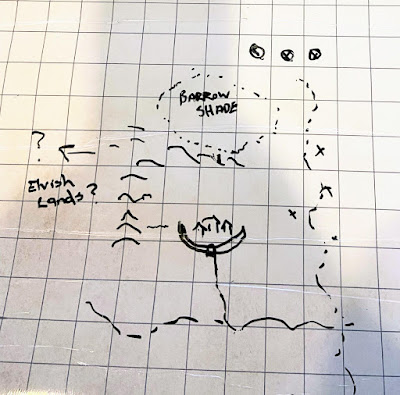
Early sketch of the campaign setting. A city, mysterious woods, strange lands

Furthermore, if players have read through or skimmed the Monster Manual there's a fair chance that most enemies will also seem familiar, and they'll start anticipating your moves and tactics. With a healthy disregard for "encounter balance" and "challenge ranks", find chances to throw your own custom encounters or variants at the adventurers.


And speaking of "encounter balance", it's no bad thing to consider how a party can be overwhelmed (or underwhelmed) as you develop your scenario, but true balanced encounters are a mirage. Provide strategic balance by allowing characters to withdraw if the opposition is too powerful, or press on with advantages they acquire though adventuring or the environment. Gives them battlegrounds where they can push a foe into a pit, control who runs across a narrow bridge, or chase down an assassin on a city-wall.

Move on from 5e

When you reach level 6 or thereabouts, consider moving on from 5e and its accelerating options and complexity. As GM, you'll face much more work for comparatively little increase in fun. Once you're familiar with the common language of D&D systems – classes, ability scores, hit points, armor class, saves – there are many alternative systems that retain the familiar D&D frameworks but also the excitement and simplicity of lower-level play.

  • White Hack: excellent flexibility and scope for player input. Can accommodate many professions and magic system/styles. Simple mechanical core; for example, combat damage only uses d6.
  • Beyond the Wall and Other Adventures: evokes traditional fantasy in the best way, and perfect for beginners and younger players. The core rules combine elements of older editions of D&D, including saving throws, with elements of 5e, but there's a solid, flexible game there. There are only three core classes, Warrior, Rogue, and Mage, but the free-form skill system and open list of spells mean it's easy to customize for professions. A ranger can be simply a warrior with tracking and outdoor survivals skills.
And finally, don't be afraid of "breaking" a finely balanced system with a few simple house-rules, especially if they ease the burden of managing combat and other intensive interactions. Rolling for initiative felt like fun the first few times, but it hampers a smooth transition to combat, and the more and varied the enemies, the more likely you are to lose track of turn order. I went to a tried and tested method of counting down by DEX score, and never noticed a problem.

Saturday, April 15, 2023

Rise of the meta-GM

If you find yourself flicking through one RPG system, like Imperium Maledictum, and thinking to yourself that it could be played with XD20 or Basic Roleplaying (BRP), then you might be a meta-GM.

Meta-gaming, from the player's point of view, is when a player uses their personal, real-life knowledge of the game rules or setting to guide their in-game character's actions. Sometimes this is useful, or at least tolerable, and sometimes this can disrupt or short-circuit a scenario. 

Meta-gamesmastering, the domain of the meta-GM, by extension, is when the GM or referee uses their personal, real-life knowledge of the patterns of RPG mechanics and game design to guide their in-game practice, improvising, interpreting, anticipating, or modifying the procedures of the game system in use at the table.

The phrase came to me because I'm in the situation of GMing for friends and players new to gaming and perforce using their preferred system—Dungeons & Dragons 5e. D&D has its faults, but for new players it's a smooth and engaging introduction to fantasy RPGs. All the same, D&D's exception-based structure and parade of feats and special cases has the tinkerer looking at how others adapt the core rules, which led me to the Dungeon Craft channel and this hugely informative take on the core mechanics of the D20 system: You Don't Need Apps to Play D&D

This really means that you don't need the D&D app, loaded with sourcebooks and rules links (or even, in fact, the rule book) to make a determination at the table about success or failure, especially within a statistically "balanced" system. The Professor DM has often referenced XD20 and, in particular, the insight that there are only 20 numbers on a d20—so however complex the decision tree around chances of success or failure, the end product is only ever a roll of a d20 with 20 possible outcomes, and for any given roll a few points either side of the target are rarely significant. 

Which, in meta-gaming terms, leads us to a table like this (with apologies to Dungeon Craft):

Roll a D20 —Did the character succeed?
20 — Yes! A 20 always succeeds and the roll is taken as a critical success
15+ —Yes — a high roll succeeds
10+ —Yes, perhaps. The character usually succeeds, if proceeding with skill OR an advantage (situational bonus, weaker enemy)
6+ — Maybe, but only with skill AND situational advantage, otherwise, mostly no; the GM decides.
2+ — No (there's always a change of failure from 1-5)
1 — Fail! The worst possible roll is always a failure or a fumble

You might notice, as a meta-GM, that this table itself only has six rows, which, with a glance at And Play, can be further abstracted thus:

Roll a D6 —Did the character succeed?

6 — Yes! A 6 always succeeds and this is often the best possible result
5+ —Yes — a high roll succeeds (unless the task is desperate or foolhardy)
4+ —Yes, probably. The character usually succeeds, all things being equal, unless the task is notably difficult or the character is challenged or unprepared)
3+ — Maybe, but only with skill OR situational advantage; the GM decides
2+ — No, unless the task is easy and the character is fully prepared; the GM decides
1 — Fail! The worst possible roll is always a failure or a fumble (always a chance of failure)

So, if the GM (or DM) is playing as a referee, mediating between the rules and the players but working within the general structure of the system, which includes adapting the given procedures for situations that aren't specifically anticipated, such as calling for an ability check when no specific rule applies, then the meta-GM is applying their knowledge of the rules and the general processes and trends to emulate the experience without strict reference or fidelity to the rulebook.

This might be the trick to FKR style play: you're still running a game, not proceeding by GM fiat, but the meta-GM has tools that generate the same experience with fewer intervening processes.

This isn't necessarily the best or easiest way to play. With a balanced, grounded system like BRP and engaged players, running encounters within the frame of the published rules can make for great sessions. Adjust the meta/in-system balance to your taste (and keep the d6 handy).

But, as I suggested earlier, if you wanted to pick up the concept of a game but not the overhead of the system itself, then the path of the meta-GM beckons. The premise of Imperium Maledictum, playing the agents of a powerful yet flawed patron against the grim background of intrigue and violence of the Warhammer 40K setting, is intriguing. Perhaps it would also work well as a gritty medieval fantasy, restaged in the mazy courts and alleyways of a city on the borderlands? Can the meta-GM then run everything with a handful of gothic-looking d6s?

A d20 and a d6 on a table

In X-Treme Dungeon Mastery 2E, the Hickmans liken their XD20 system to the custom car engine that the GM has to attach to the transmission to turn the wheels of the game. That’s the meta-GM role: assembling the engine and welding it to the chassis to make the custom vehicle for their game, their adventures. The particular parts you choose—d6, d20, d100—classes, skills, abilities, counters, and stage-dressing, are all up to you.


Monday, November 1, 2021

One Sheet Rules — Your Old School Experience

The OSR movement (the Old School Rules/Revival/Renaissance, etc.) has, over the years, brought to light a lot of interesting rules and ideas, but a recent instance, namely Bill King's One Sheet Rules, seems well worth the time to consider. 

Taking inspiration from early editions of D&D, The Black Hack, Knave, and other OSR and rules-light systems, the One Sheet Rules are an ultra-light, flexible system that takes many familiar OSR concepts and shapes them into a compact framework that would be just enough for any OSR style adventuring.

The simplicity of One Sheet Rules is outstanding. For example, almost every step in character creation is an easy to remember rule of "three": three points go to three abilities (STR, DEX, INT), you begin with 3d3 hit points, you choose three items of equipment or spells, and so on. The basic system, roll d20 and roll high against a target, is cleverly configured so that, if you choose, only players ever need to roll. To run an encounter, all you need to know is the level of the opposition, which serves rather like the HD rating of older systems. There is a experience system, but "advances", like experience rolls in RuneQuest, are based on rolls, not accumulated experience points.

Is it perfect? No. But it is imminently adjustable, and that's what matters. Personally, I would give characters slightly more hit-points in the beginning, like RuneQuest, but with a flatter accumulation and a maximum of about 18. And I would decouple Monster levels from hit points, so PCs could face a frail but deadly-swift foe, or a weak attack from a massive creature that takes considerable damage to drop. But both of these decisions are but a moment to make and easily ported to the rules.

With the Once Sheet Rules, it's possible to convert adventures and even whole campaign settings on the fly. I've sometimes wondered what it would take to pick up and run an old MERP adventure or start playing in the Old World or Warhammer without the cumbersome original rules. Although Basic Roleplaying is always an option, ultralight systems like One Sheet Rules are even faster to adapt.

Where to find them

The One Sheet Rules can be hard to find, and the Tinkerage only came across them by chance.

The One Sheet Rules by William King are available on itch.iohttps://billk.itch.io/one-sheet-rules

You can also subscribe to the One Sheet Review mailing list (links in the rules), which allows you to receive the One Sheet Magic and Monsters edition, which includes a basic bestiary and spell list (highly recommended).


Monday, November 17, 2014

A micro-review

A system for Tony Dowler's perfectly compressed micro-dungeon maps?

Try the ultra-concise Deeds & Doers.

Only players roll – 'to do' – when there is a significant risk.

The DM applies injuries and conditions with judgement, not hit points.

A game you can hold in your head.

Fantasy dungeons, sword and sorcery, all by suggestion. Pick your source; then where, who, why.


Wednesday, April 9, 2014

Is there an RPG in this dungeon?

Looking through the beta rules for Dungeon Robber (the solo, pen-and-paper random dungeon-delving game), the tinkereage wonders if there is not a viable multi-party RPG hidden within these rules.

Dungeon Robber is now online in flash-format as a sort of hybrid rogue-like/OD&D dungeon crawler. It's a fun, often frustrating game, but the thrill of random dungeon creation and solo resource management in the face of arbitrary death by statistical misadventure does not last long.

But looking through the 'rules' behind the browser game, there is enough content to forge a working RPG which would resemble a streamlined version of the original dungeon-crawling system. Take the character generation rules, the classes, and the very compact method for creating monsters based on 'home level', add a simple task resolution system based on the saving throw (with modifiers for hard/easy tasks) and one would have a simple, workable system ready to go.

The only drawback is that combat would have the swift and deadly feel of OD&D. But then, wouldn't raising the threat of monster encounters bring a new feel to the old game?

Tuesday, February 4, 2014

XD20: an appreciation (and thoughts for Dungeons and Dragons)

Since this year is the 40th anniversary of the Dungeons and Dragons system, this year's first post takes a quick look at an obscure off-shoot of that famous game, XD20.

XD20 is an extremely free-form, rules-lite system included in XDM: Extreme Dungeon Mastery, a guide to DMing and RPGs by Tracy Hickman and Curtis Hickman. XDM as a book shows signs of hasty development and editing, as well as containing considerable filler in the form of mostly unusable stage-trickery and dice prestidigitation, but at its core there is also a sound and interesting guide to bringing fun, action, humour and interest back into roleplaying games, as a reaction to the slow, overly-cautious, procedural style of dungeon-crawling play that D&D games can slip into.

This review on RPG.net is a pretty good summary of the XD20 system, and interested me enough to buy the e-book version through Kindle.

In brief, the 'advanced' version of XD20 generates characters with three scores or stats: TAC (Toughness and Constitution, the only acronym that is explained), PSYCH (intelligence and skill), and WAH (luck, willpower, and magic specifically). There is also a Health score, based on a combination of the other scores. Characters have a few notes regarding skills and abilities (based on their character Type) a Level, and any equipment the DM deems reasonable at the time.

The three scores combine ability scores, bonuses and saving throws, and so lower numbers are better (except for Health, oddly).

The mechanics are even simpler. The player describes an action, and the DM may ask for a related stat and apply any modifiers that seem relevant or entertaining and sets the target number. The player then rolls greater than or equal to the target number on d20 to succeed. If the success or failure has some effect, like damage or magical strength, then another d20 is rolled and the higher the roll, the better. In essence, the DM estimates the chance of success based on a stat or the situation, and sets the target number accordingly.

Combat rounds are unstructured. The only rule is that everyone gets a chance to act in a single round, and damage is fudged – you can roll, or apply a fixed number, or the DM can make something up.

The mechanics may seem sketchy and rather arbitrary, and in a sense they are. But XD20 captures a deep truth about RPG systems which has influenced my thinking considerably: there are only 20 digits on a d20, and most rules in all their calculations, modifiers and tables are ultimately aimed at proposing a number that seems fair given the situation: so why not just cut to the chase, pick a reasonable target, and roll?

The handling of magic has a similar elegance. A magician describes a spell, the DM sets a target number, the roll is made and the effects decided. The Hickmans point out that magic should be consistent with the rest of the rules of the game and the nature of magic in the game-world, not based on exceptions and special cases. This of course requires inventiveness as well as consistency and a great deal of judgement, but it also pushes players and DMs to treat magic as, well, magic, rather than a sort of special in-game munitions in prepackaged units.

Finally, although characters have a Level, there is no material benefit from gaining a level (which happens whenever the DM thinks it should happen). Instead, characters simply face challenges and opponents consistent with their level and the general difficulty of play remains the same.

XDM is clearly based on playing and revising D&D, with its vast lists of specialist classes, optimal "builds", spells, special abilities and feats, and countless modifiers, options and case-based exceptions. After all, everybody knows what a fighter or a barbarian or a wizard should do, what equipment they carry, what they can face at first level or tenth level. XD20 urges players and DMs to cut away the detritus and focus on the action, puzzles, roleplaying and story. With a few scores on the character sheet for fighting, skill and magic, some health points, a few dice, a few equipment tables to adapt and plenty of imagination and judgement, what could be closer to the original spirit of the first fantasy RPG?

Of course, the XD20 system is not perfect, and even some of its very few rules (in particular, how Health is figured) run against common-sense, which can hamper engagement. But its core ideas present a huge amount of flexibility, and I'll be looking at these options in an upcoming post.