Showing posts with label micro rpgs. Show all posts

Monday, January 20, 2025

Roll 6 or Roll 9: Blade and Haversack

 A quick note on a recent find. Blade & Haversack on the msjx blog is a neat 2d6 iteration of the concepts of Sword & Backpack, but I also noticed that the B&H target numbers – 6 for Average, 9 for Hard, 11 for “nigh Impossible” – align very closely with the scale for Roll and Read on 2d6, as seen here.

Maybe it’s because 6 is half of 12, but there’s something quite satisfying about rolling for 6+ for an average or routine task, where skill and circumstances come together, and the next check of 9 neatly flips the chances of success to about 1/3.

B&H also introduces Stress Points to manage “hits” and other categories of challenge, like multiple successes to unpick a complicated lock. Like any other ultralight system, including Sword & Backpack, you need to do some of the development yourself to arrive at a playable game. But it’s nice to see how these principles converge.

Sunday, January 2, 2022

Many ways in (to the FKR)

The Many Ways Inn is famous for standing at the meeting of three great roads on the chaotic margins of the Harrowmarch, and infamous for the many adventurers and ne’er-do-wells who gather there seeking rumors of suspect ventures.
Over the last couple of years(!) circumstances as well as interests have guided the tinkerage farther in the  direction of free-form, minimalist rules — or the Free Kriegsspiel Roleplaying (FKR) style of gaming, lead by play worlds, not rules principles.

Now there are plenty of resources online to learn more about FKR, and the Green Dragon and Fighting Fantasy systems I’ve discussed earlier are also an introduction to this style, but in the next few posts I’m going to delve into some of the many ways in to free-style gaming that have developed.

But first, a note about FKR play.

FKR is based on the innovation of the original “frei kriegsspiel” wargames, where detailed and systematic resolution methods were discarded in favor of an experienced referee or adjudicator. 

Hence, a free-form toolkit has these elements:

  • A world, being the shared setting for the game and its scenarios. This world can come from an existing game (like the dungeon-y system), an existing fictional world (like the Star Wars universe or Middle-earth), or, of course, the referee and players’ own invention. That being said, the world serves best as a starting point: it’s a place to enter and explore, to map and develop. And although a trend in some FKR circles has been to lean towards playing in existing fictional worlds and genres, for me it’s the creation of one’s own world with rules-light play that offers the most fun and challenge, while (as I’ve said in my Play ALL the Books posts) it’s hugely productive and fun to ransack all the sources you have at hand for tools and inspiration.
  • A format for characters. This is usually diegetic, meaning that simple description tells you about the character in terms of the game-world, not with reference to detailed metrics like stats and ability modifiers, hit points, skills, and so on. See Getting in to Character here, for an example.
  • A resolution system that is as minimal as possible, so that it operates behind and not in front of the character’s choices. See Getting into Adventure for an example.

The key to play-the-world or FKR gaming is not that every action is determined by referee fiat, but that the players concentrate on their characters and the situation, and the referee is equipped to apply, through judgement and experience, with a set of tools for resolution that are both fair and simple to execute. It’s not that there are no mechanics, but that the mechanics are compact and easy enough to generate the chance element that means that the play is not simply dictated but develops in unexpected and dramatic ways as it runs.

Monday, November 1, 2021

One Sheet Rules — Your Old School Experience

The OSR movement (the Old School Rules/Revival/Renaissance, etc.) has, over the years, brought to light a lot of interesting rules and ideas, but a recent instance, namely Bill King's One Sheet Rules, seems well worth the time to consider. 

Taking inspiration from early editions of D&D, The Black Hack, Knave, and other OSR and rules-light systems, the One Sheet Rules are an ultra-light, flexible system that takes many familiar OSR concepts and shapes them into a compact framework that would be just enough for any OSR style adventuring.

The simplicity of One Sheet Rules is outstanding. For example, almost every step in character creation is an easy to remember rule of "three": three points go to three abilities (STR, DEX, INT), you begin with 3d3 hit points, you choose three items of equipment or spells, and so on. The basic system, roll d20 and roll high against a target, is cleverly configured so that, if you choose, only players ever need to roll. To run an encounter, all you need to know is the level of the opposition, which serves rather like the HD rating of older systems. There is a experience system, but "advances", like experience rolls in RuneQuest, are based on rolls, not accumulated experience points.

Is it perfect? No. But it is imminently adjustable, and that's what matters. Personally, I would give characters slightly more hit-points in the beginning, like RuneQuest, but with a flatter accumulation and a maximum of about 18. And I would decouple Monster levels from hit points, so PCs could face a frail but deadly-swift foe, or a weak attack from a massive creature that takes considerable damage to drop. But both of these decisions are but a moment to make and easily ported to the rules.

With the Once Sheet Rules, it's possible to convert adventures and even whole campaign settings on the fly. I've sometimes wondered what it would take to pick up and run an old MERP adventure or start playing in the Old World or Warhammer without the cumbersome original rules. Although Basic Roleplaying is always an option, ultralight systems like One Sheet Rules are even faster to adapt.

Where to find them

The One Sheet Rules can be hard to find, and the Tinkerage only came across them by chance.

The One Sheet Rules by William King are available on itch.iohttps://billk.itch.io/one-sheet-rules

You can also subscribe to the One Sheet Review mailing list (links in the rules), which allows you to receive the One Sheet Magic and Monsters edition, which includes a basic bestiary and spell list (highly recommended).


Wednesday, May 1, 2019

Play the World

Searching the for insights into the 'free-form" role-playing procedures of some of the earliest GMs and designers, the Tinkerage came across an intriguing series of posts called "Play the world, not the rules" on Darkworm Colt.

This is a method that you can summarize on a page, uses only six-sided dice, descriptive character generation, and just two basic mechanics. And the point of this is that the rules, the "Visible Rulebook" to borrow a term from from S. John Ross, are necessary only to the extent that they facilitate the interaction between the players, their characters, and the worlds they want to explore.

Here's the method for playing the world:

1 - Characters

Briefly describe your character, including notable attributes, like skills, characteristics, or professions (maybe five or so). One or two attributes may count as outstanding (use two words for emphasis like "excellent tracker"). The necessary level of detail is to create a playable role.

If you're stuck, roll dice to help you decide on your attributes, and refer to any work of fiction, rule-set or character generation system for ideas about stats and skills, professions, and backgrounds.

In general, a modifier for a notable one-word attribute is +1, an outstanding two-word attribute (skilled swordsman, talented pilot) is +2, and rare superlative attributes (exceptional swordsman; best pilot in the system) are +3.

2 - Tests

When you need to account for risk or uncertainty, roll the dice. An average roll (around 7) is average, you most likely continue but the situation is not necessarily resolved, high is good (around 9+) and usually decisive, low (around 5-) is bad and entails negative consequences.

Apply modifiers for suitable character attributes and the situation and equipment in the +3 to -3 range.

3 - Opposed rolls

Roll the dice for opposing efforts (such as combat, but also other cases of active opposition) and compare. Highest wins, and the bigger the difference the more decisive the outcome. Apply modifiers, as for tests.

4 - Hit points

Darkworm Colt uses a "three strikes" system: character can take three hits and then they're out. Tougher characters might have more hits at the GMs discretion.

For the sake of greater flexibility, I'd suggest six hits, with stronger characters adding 1 or 2 more as indicated by a suitable attribute. Lighter attacks deal 1 hit. Heavier attacks can inflict 2 or 3 hits. The GM should apply judgement and err on the side of character survival. A character at exactly zero hits is stunned, staggered, dropped, and so on, but not dead.

5 - Play the world

The game isn't in the method; the game is in the sources you choose for inspiration, in the worlds you construct, and in the scenarios the GM devises and the creativity players bring to them.


Tuesday, June 13, 2017

Reviews - Tiny Dungeon and Dungeonpunk

Two low-cost games show the potential, and limits, of rules-lite and free-form RPGs.

Tiny Dungeons

Tiny Dungeon, by Brandon McFadden, Smoking Salamander Games, is a rules-lite, well-produced fantasy RPG that relies on an extremely simple dice mechanic. In fact, there are only three kinds of test, a standard test, a test with advantage, and a test with disadvantage, and consequently exactly three probabilities to roll for. Adventurer characters are also simple, having a race, a short list of Traits, a Weapon Proficiency, and a fixed number of Hit Points. Weapon Proficiencies and Traits confer advantage on tests, neither armor nor weapon type have any effect in combat (a hit is one Hit Point), and that's pretty much the game.

The Traits list is interesting and well-chosen, and would offer a variety of ways to make a character, although the race list is close to what you might expect of a generic fantasy. The low-key magic is interesting and essentially freeform. The Spell-Touched trait confers the ability to cast a variety of minor magics at the GM's discretion, while a Spell Reader can read spell scrolls to greater effect (though the scroll contents are also up to the GM).

Since there are only three probabilities, it's fair to ask why the system doesn't use the same dice roll with an "easy, standard, hard" target number, rather than adding or subtracting a die to generate advantage or disadvantage, but in such a simple system, this hardly seems difficult. One consequence of this system is that a standard test has a reasonable chance of success, which makes it harder for characters to hide effectively (since creatures have a fair chance of spotting them), and also more likely that combats will be decided not by skill but the higher Hit Points.

The PDF is well-designed, with engaging, somewhat cartoon-style artwork, and there's room in the short document for a scenario, as well as some GM advice. Given the scope of the rules, the system might not carry you through a long campaign, but there's certainly enough there for a few adventures, with few barriers to engagement or fun.

Dungeonpunk

Dungeonpunk, by Eric C. Medders, is a free-form system that presents itself as fun and easy, but lacks coherence when it comes to figuring out how you actually play. The tone and approach are intriguing, but sometimes the details matter.

Dungeonpunk, much like Sword & Backpack, takes a freeform approach to the rules. Characters have a class and a brief description, and are backed by 5 all-purpose Destiny Points. The essence of the system is: roll high good, roll low bad, 1 fumbles and 20 crits. There's a lot to like in a system with no modifiers, ever, where the roll is considered "'outside' the game itself." But what is a "high roll" or a "low roll"? There are no guidelines, not even something like the rough chances, to help eyeball the probabilities. Furthermore, some rolls are against a Difficulty Class (DC), a target number, whereas in other situations you simply look at the number on the D20 and take it from there. So when do these apply? In combat, there's mention of an attack and defense roll, but then the result seems to be a matter of comparison: highest roll wins. In which case, why does the scenario at the end use a system by which the players score so many hits per points rolled on the D20?

Now, in line with the punk aesthetic, the Game Master section advises you to "Make the game up as you go", but although punk is brash and anarchic, it's also tight and fast, and this approach comes close to getting bogged down in a mix of GM say-so and uncertainty. On the one hand, it's liberating to be able to write instead of roll a character, but what we're looking for with freeform is a set of clean procedures and mechanics that can serve the moment and also provide a flexible frame for resolution, and Dungeonpunk isn't quite there yet.

Unlike Tiny Dungeon, the Dungeonpunk PDF is a simple text document with a handful of stock-art images, and its clarity further suffers from a lack of proof-reading and consistency (at one point, for example, the text mentions a "Plot Roll", which sounds fine, except the term is never explained). Nevertheless, if Dungeonpunk was tighter and clearer, it could potentially offer a lot more depth of play over time, because freeform provides space for elaboration and development from a simple set of rules.

Tuesday, June 7, 2016

Roll and Read advanced version

This post picks up on the system for Roll and Read solo play, with a different die and extended for group RPG play. It's also based on a micro-system submitted for the 200 Word RPG Challenge.

Roll and Read

The key to Roll and Read is that, however you set up the character, the player and the GM agree on the expected outcome of the action before the die is rolled. If the die comes up high, then things go better for the character; if the roll is low, things are worse.

In this case, a warrior is expected to hit a foe, a wizard is expected to cast a spell, a scout is expected to pass unseen through cover. If the task is harder for some reason, then only partial success can be expected, and the character needs a lucky or even exceptional roll to do well. On the other hand, if the task is easy, then only an awful roll will have an effect on the outcome, although an unlucky roll may cause complications. There are no modifiers, ever, because the circumstances are already built in to the range of expectations.

The system also heads off the effect of pure dumb luck. A novice won't necessarily fell a master because of a lucky critical; a master won't necessarily foul up utterly because the die rolls low.

The advanced system uses a d10, because the range of results can be split into five categories, and centers on the expected outcome.

When you meet danger (skirmishes, traps, natural hazards), discuss the expected outcome, take action, and then roll a 10-sided die. The GM will determine the consequences accordingly.
1-2: Awful/Poor
3-4: Unlucky/Weak
5-6: Expected/Middling
7-8: Lucky/Strong
9-10: Advantageous/Exceptional
As before, if the character seems to hold a great advantage in terms of skill or circumstance, then roll two dice and take the best.

And, if the roll seems like sheer bad luck or runs against expectations for the character, then the player may spend a point of Res to reroll (representing the character's effort and resolve). If this roll is Exceptional (9-10), then the Res point is not lost.

Characters in Roll and Read

Characters can be generated free-form, with a short list of skills, abilities, knacks, and characteristics. 

They have one common score, Resources/Resilience (Res), a measure of resourcefulness, resolve, level, luck, and even hit points. If you want to take an experience levels approach, then character can begin with Res [1] and gain Res as they adventure. If you want characters to have a better chance of survival from the start, begin at Res [3]. Res should be used to represent character ability by gaining rerolls on critical efforts.

Combat

Combat is a matter of rolling, comparing, and reading a result. Hence, a squad of attacking gremlins might pose a slight threat for an armed warrior. In combat against these gremlins, if you’re Unlucky, you’re hit. This character would stand on equal or slightly better terms with a ragged goblin, and so probably wound with an Expected/Middling roll, and a Strong roll would read as a vital hit. But even an armed and armoured knight would have to be make an Exceptional roll to hurt a powerful dragon.

Where the roll is low enough that the character is wounded, deduct a point of Res. When the last point of Res is lost, the character is out of play for the rest of the scene. The player can then decide whether the character continues on play or is discarded.

[This section updated 11/23/16]

Encounters and Hazards

For the sake of comparison, encounters, and hazards, can be ranked on the Poor to Exceptional scale. Encounters can also have individual or group Res.

Thursday, February 18, 2016

A quick conversion - XD20 and Sword & Backpack

Not too long ago, the Tinkerage mentioned the ultra-light Sword & Backpack system. The rules of Sword & Backpack are minimal: roll a d20 and decide what's fair. But with a little tinkering, Sword & Backpack could be adapted to XD20, or my still nameless D20 adventure rules.

Here's how it goes. In Sword & Backpack you can play as either a Warrior, Rogue, or Sorcerer. These are types rather than classes, but we can all guess that the Warrior excels in combat, the Rogue in subterfuge and skill, and the Sorcerer in magic. Hence, we can map these to XD20 stats, or Fighting, Skill, and Magic.

Warrior (WAR) = TAC/Fighting
Rogue (ROG) = PSYCH/Skill
Sorcerer (SOR) = WAH/Magic

Assign the three scores (WAR, ROG, SOR), takes the best score as the character's primary role, figure out hits and what-not (possibly a simple three-strikes-and-you're-out system), and you're ready to play. Each character type will be able to do a little of what other types can: a sorcerer can engage in light swordplay, a rogue can read a magic scroll.

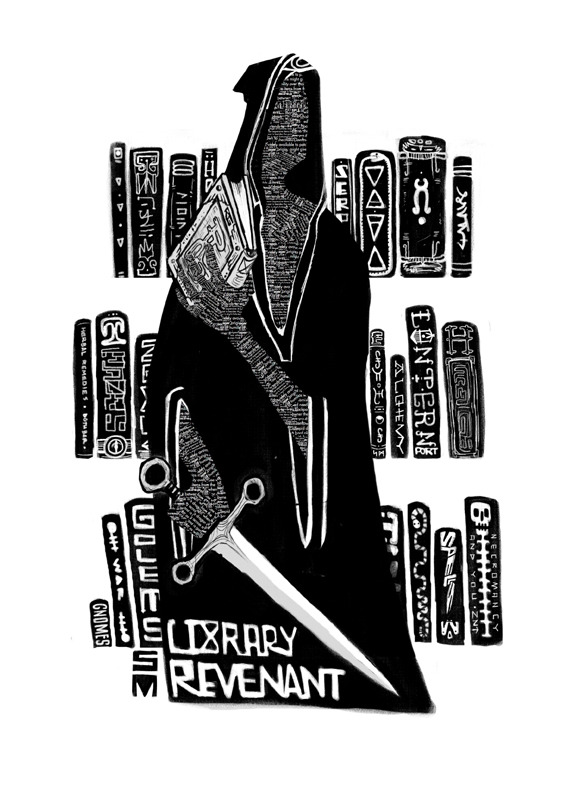
Once you have your characters, why not try the scenarios in the Lanternport adventure setting, because, really, nothing can beat delving into a vast, magical library guarded by traps and bookwyrms, and patrolled by eerie undead librarians.

Art by Sam Mameli
Library Revenant - Art by Sam Mameli


Monday, November 17, 2014

A micro-review

A system for Tony Dowler's perfectly compressed micro-dungeon maps?

Try the ultra-concise Deeds & Doers.

Only players roll – 'to do' – when there is a significant risk.

The DM applies injuries and conditions with judgement, not hit points.

A game you can hold in your head.

Fantasy dungeons, sword and sorcery, all by suggestion. Pick your source; then where, who, why.