Wednesday, November 5, 2025
The UGE Review: Basic Roleplaying 2023
The 2008 edition of Chaosium's Basic Roleplaying (BRP), a solid book with a bright yellow cover and distinctive cover design, is often referred to as the "Big Golden Book" or BGB. In terms of impact, it's one of the most significant RPG releases in the history of the hobby.
Often referred to as a systems tool-kit, it could also be thought of as a compendium, a collection of games. The BGB effectively contains RuneQuest, Call of Cthulhu, Stormbringer, and the outline of a system for sci-fi and supers, all based on a direct and highly playable system and a collection of spot rules that easily scales in complexity and detail. If the BGB has a weakness, the number of options can be overwhelming and there are a lot of choices to navigate from the idea of a game to play at a table. But as someone who had spent years with RuneQuest 3, applied as a generic base for fantasy, it was a seamless transition from the BGB to a successful campaign set in Middle-earth.
BRP in 2023 comes in a revised edition subtitled "Universal Game Engine" and so the UGE is the new BGB, though it shares the same iconic cover illustration. The virtues of BRP are are still fully present. The system is consistent and flexible. In practice, one of the most astounding things about a book the size of BRP is that it mostly stays behind you on the shelf. Once the characters are generated and the GM has prepared the scenario, everything you need to play is in the sheets and notes before you. Then you can close the book and put it aside. Since most checks are percentile, roll under against a given value, it's easy to glance down and assess the chances of success without a stack of modifiers; and since it's skill-based, there isn't a reference-sheet of special abilities and cases-by-case instances to consider. The rules fit together logically, and so it's easy to house-rule and adapt from a few basic principles.
Overall, any edition version of BRP feels grounded and believable. Hit points are tied to Strength and Constitution, so they don't keep escalating and soar above the level of stress and damage a person could conceivably take. Skill gains are incremental and tied to actions the character takes. The aim is not accurate simulation but verisimilitude, the sense that the fiction is credible and runs true to plausibility and expectation.
The revisions for UGE are well-chosen and necessary. Character generation is slightly streamlined and the options are better explained. The skill descriptions have less detail of the various levels of success (critical, special, etc.), which were not often referenced at the table. The bestiary section displays characteristic scores in a horizontal table, which saves space and is easier to read. The illustration style is more coherent and the images are generally interesting and evocative, although they tilt somewhat to historical settings.
The gains in layout make it all the more unfortunate that the tables are presented in a squintingly small typeface, which is hard to read even with sharp eyesight (or glasses on) and bright lighting. No one, for instance, is going to be able to roll and then quickly look up a result on the Major Wounds Table in the middle of play. The need for readable tables alone is a good reason to keep one's old copy of the BGB at hand during a session.
Apart from that, I have a few minor gripes: scope for changes in BRP that the UGE could have included. Given the "universal" tag, it would be nice to have at least one version of a fantasy or pre-modern character sheet that didn't list modern skills. Noting will knock you out of the moment than your elf character player sorting though a list of skills that include Psychotherapy and Heavy Machinery. And, given that the system is meant to be scaleable to different power levels, why is there no option for giving magicians more power to deal damage in combat? A single magic spell level which yields 1d6 damage costs a sharp 3 power points, which means that on average a magician is spending almost a power point per point of damage dealt.
Of course, the UGE gives you the tools to dial up and down the complexity of your game and transfer concepts seamlessly between settings – with a little work – but that's why it's so powerful as a base system. UGE is an "old school" system in that it doesn't present a pre-packaged and thematically pre-scripted world for you to start in, but a familiar, grounded, and conceptually coherent system from which you can build your own worlds and adventures.
Sunday, March 2, 2025
Play the (Disc)World
Here’s a thing that can sometimes happen when someone is interested in starting out with play the world or FKR gaming:
New Referee: I want to get started with FKR gaming.
FKR: Great! All you need are players ready to describe their character, a world to play, and an experienced referee to adjudicate.
New Referee: Well, I have some experience with other RPGs, but I’m not sure how to resolve actions without some sort of rules mechanics and guidance. What should I use?
FKR: Well, you’re the referee now. How about opposed rolls, roll high, percentiles, roll and read, dice chains, dice less?
New Referee: But I’m just getting started. Can I get some guidance on the mechanics and adjudication?
FKR: You’re the referee now. You decide.
And so it goes.
Now you can start on the Discworld
- A complete free-form resolution mechanic: the player describes their action, based on any element of their character sheet. The referee assigns an Outcome die from d4 to D12 based on the character’s traits and situation. The referee only ever rolls a d8 because the chance of success is relative, but this is also a nod to Discworld lore.
- Depending on the rolls, the referee resolves the consequences, from success to mixed success to consequences from Inconsequential [sic] to Minor, Major, and Exceptional. These occupy the character sheet until resolved. The character has a small pool of Luck to help manage consequences.
- Sample characters, and since characters a wholly based on description, it’s easy to infer that character generation is just a matter of specifying Organization, Background, Niches (2), Quirks (2), and Core (belief). In effect, a complete character gen system.
- Organization: Thieves Guild of Blackwillow
- Background: Raised in the shadow of the Noose
- Niche: Deft pickpocket
- Niche: A stab in the dark
- Quirk: Often overlooked
- Quirk: The meddling priest sees your good side
- Core: Slip by, right under their noses
Wednesday, June 12, 2024
That Year in the D&D20
But there you go. When friends want a visiting GM – no DM – to help get started, why turn down a chance to try the system?
Here are some observations and non-binding recommendations.
5e is great for beginners
I didn't expect this, but for a first game session or three, 5e is great for beginners. New players with new characters feel capable, but with low hit points they're also vulnerable. Low-level threats are interesting, but usually go down after 1–2 hits, enough to pose a threat but not overwhelm. Players have a few custom options, but they're much more likely to be inventive and try fun strategies.
It's also interesting how many D&D rules seem designed to remove inconvenience or difficult choices. When I pointed out the finesse weapon rules, the dextrous halfling suddenly gained another level of damage with melee weapons.
Leveling up works, until it doesn't
Gaining levels is fun, and characters feel incrementally stronger and more capable, giving you scope to introduce more substantial threats – at least at low levels. But there are rocks ahead. Even within a few levels, there are more options, more special abilities, more feats to accommodate, and the complexity and number of considerations rises rapidly. Our campaign reached Level 4 – milestone leveling, not by experience points accountatncy – after just over a year of intermittent, mostly monthly play. I doubt the game is as easy to run after Level 6.
Rules? What rules?
For a year, I DM-ed mostly without a rulebook. I picked up the basics of how to run the game because I read the free, online Basic Rules, not to mention any one of the dozens of excellent retro-clones online.
D&D Beyond is a terrible app, but it's got most of what you need for 5e with the Basic Rules. The full online SRD has the rest. The players needed the Player Handbook, because they need all the trinkets and bolt-on abilities that come with leveling up (see above). If you have experience as a DM for any system, you can mostly create rulings to carry you through (Ability checks, screening rolls an a d6 or d20).
And there are many rules that you can dispense with or adjust. Too many characters can see in the dark. Short rests are extra HP on tap and encourage stilted adventuring (fight, rest – fight, rest). You can work without a lot of them.
Speaking of which, monster stat blocks are ridiculously long and detailed. I used a flat 1-2 line format (and you can find almost any D&D monster online with a simple search).
For instance:
GOBLINS
In+2*, Spd 30, HP 9, AC 15 Treated Hide, Spears +4 (1d6+2 pierce); light x-bow +4 (1d6+2 pierce)
*modifier to initiative roll
HOBGOBLINS
In +1, Spd 30, HP 15, AC 18 chain+shield; Longsword +5 (1d8+3)
+2d6 damage if striking in battle-line (martial advantage)
Use your own stuff
While there's nothing wrong with leaning on source books, the implied setting of the D&D rules is a veritable mishmash, a trope salad. Use your root and branch campaign ideas, and develop your own setting. Your player will appreciate a world to discover, not a tour.
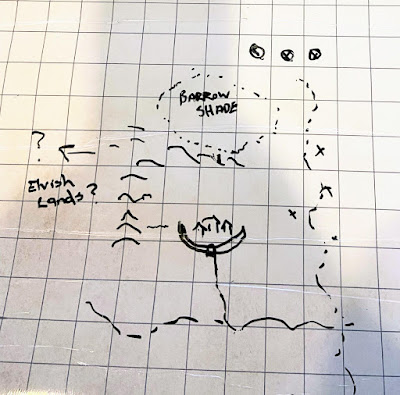
| Early sketch of the campaign setting. A city, mysterious woods, strange lands |
Furthermore, if players have read through or skimmed the Monster Manual there's a fair chance that most enemies will also seem familiar, and they'll start anticipating your moves and tactics. With a healthy disregard for "encounter balance" and "challenge ranks", find chances to throw your own custom encounters or variants at the adventurers.
And speaking of "encounter balance", it's no bad thing to consider how a party can be overwhelmed (or underwhelmed) as you develop your scenario, but true balanced encounters are a mirage. Provide strategic balance by allowing characters to withdraw if the opposition is too powerful, or press on with advantages they acquire though adventuring or the environment. Gives them battlegrounds where they can push a foe into a pit, control who runs across a narrow bridge, or chase down an assassin on a city-wall.
Move on from 5e
When you reach level 6 or thereabouts, consider moving on from 5e and its accelerating options and complexity. As GM, you'll face much more work for comparatively little increase in fun. Once you're familiar with the common language of D&D systems – classes, ability scores, hit points, armor class, saves – there are many alternative systems that retain the familiar D&D frameworks but also the excitement and simplicity of lower-level play.
- White Hack: excellent flexibility and scope for player input. Can accommodate many professions and magic system/styles. Simple mechanical core; for example, combat damage only uses d6.
- Beyond the Wall and Other Adventures: evokes traditional fantasy in the best way, and perfect for beginners and younger players. The core rules combine elements of older editions of D&D, including saving throws, with elements of 5e, but there's a solid, flexible game there. There are only three core classes, Warrior, Rogue, and Mage, but the free-form skill system and open list of spells mean it's easy to customize for professions. A ranger can be simply a warrior with tracking and outdoor survivals skills.
Friday, October 13, 2023
On Converting Your FRP Rules System
One of the intriguing sections of the old Iron Crown Enterprises modules for Middle-earth using MERP or Rolemaster (MERP/RM) was the section that sometimes appeared in the introduction: "Guidelines for Using Your FRP System with this Module: Conversion Notes". Not the snappiest title, but the table for converting between d100, d20, 3d6 stats, and even 2d6, contained the suggestion, even if impractical, that the mechanical bones of the module could in some way be translated and adapted between game system, providing a way into ICE's resources for Middle-earth without their cumbersome house system,
The best of ICE's modules were packed with detail and context, including excellent maps and locations, but they were often thin on actual scenarios. These materials were more like a campaign overview or a sandbox setting that assumed there would be a great deal of GM design and adaptation to draw out playable adventures from the details. If you could adapt to a simpler system, how much easier would it be to leverage to module content?
Of course, Basic Roleplaying, now in the new Universal Game Engine edition, would be an excellent solution and provide for extended campaign play. But what about a simple, universal, free-form system like XD20? Could this allow you to dive into the ICE Modules – and even capture the tone and style of MERP/RM – without the overhead of a point-by-point mapping to BRP.
Here's some tinkering with the idea.
Running ICE Middle-earth Modules with XD20 2ed
MERP Characters in XD20
- TAC: record as ST (Strength/Toughness) – this is the prime characteristic for a warrior or ranger
- PSYCH: record as IT (Intelligence/Intuition/Initiative) – this is treated as the prime for scout/bard
- WAH: record as PR (Presence/Resolve) – prime characteristic for mage/animist
Other characteristics
Level: corresponds loosely with MERP/RM levels, mainly as a way of estimating the challenge comparatively.
Profession: use the MERP/RM professions in place of XD20 Character Type. Since there are no explicit skills in XD20, profession stands in for the skills and knowledge the character can most likely apply.
Background: Use the MERP/Middle-earth backgrounds to fill in the XD20 Story and Backstory.
Additional details
- AT: Armor Type, not strictly necessary in XD20, but the RM system had a neat chart converting armor worn to a 1–20 value that could stand as a handy to-hit target number.
- Melee OB: the close combat to-hit modifier (offensive bonus) – use ST
- Ranged OB: the ranged combat bonus – use IN
- Spells OB: the "directed spells" bonus – use PR
Roll on
Saturday, April 15, 2023
Rise of the meta-GM
If you find yourself flicking through one RPG system, like Imperium Maledictum, and thinking to yourself that it could be played with XD20 or Basic Roleplaying (BRP), then you might be a meta-GM.
Meta-gaming, from the player's point of view, is when a player uses their personal, real-life knowledge of the game rules or setting to guide their in-game character's actions. Sometimes this is useful, or at least tolerable, and sometimes this can disrupt or short-circuit a scenario.
Meta-gamesmastering, the domain of the meta-GM, by extension, is when the GM or referee uses their personal, real-life knowledge of the patterns of RPG mechanics and game design to guide their in-game practice, improvising, interpreting, anticipating, or modifying the procedures of the game system in use at the table.
The phrase came to me because I'm in the situation of GMing for friends and players new to gaming and perforce using their preferred system—Dungeons & Dragons 5e. D&D has its faults, but for new players it's a smooth and engaging introduction to fantasy RPGs. All the same, D&D's exception-based structure and parade of feats and special cases has the tinkerer looking at how others adapt the core rules, which led me to the Dungeon Craft channel and this hugely informative take on the core mechanics of the D20 system: You Don't Need Apps to Play D&D.
This really means that you don't need the D&D app, loaded with sourcebooks and rules links (or even, in fact, the rule book) to make a determination at the table about success or failure, especially within a statistically "balanced" system. The Professor DM has often referenced XD20 and, in particular, the insight that there are only 20 numbers on a d20—so however complex the decision tree around chances of success or failure, the end product is only ever a roll of a d20 with 20 possible outcomes, and for any given roll a few points either side of the target are rarely significant.
Which, in meta-gaming terms, leads us to a table like this (with apologies to Dungeon Craft):
Roll a D20 —Did the character succeed?20 — Yes! A 20 always succeeds and the roll is taken as a critical success
15+ —Yes — a high roll succeeds
10+ —Yes, perhaps. The character usually succeeds, if proceeding with skill OR an advantage (situational bonus, weaker enemy)
6+ — Maybe, but only with skill AND situational advantage, otherwise, mostly no; the GM decides.
2+ — No (there's always a change of failure from 1-5)
1 — Fail! The worst possible roll is always a failure or a fumble
You might notice, as a meta-GM, that this table itself only has six rows, which, with a glance at And Play, can be further abstracted thus:
Roll a D6 —Did the character succeed?
6 — Yes! A 6 always succeeds and this is often the best possible result
5+ —Yes — a high roll succeeds (unless the task is desperate or foolhardy)
4+ —Yes, probably. The character usually succeeds, all things being equal, unless the task is notably difficult or the character is challenged or unprepared)
3+ — Maybe, but only with skill OR situational advantage; the GM decides
2+ — No, unless the task is easy and the character is fully prepared; the GM decides
1 — Fail! The worst possible roll is always a failure or a fumble (always a chance of failure)
So, if the GM (or DM) is playing as a referee, mediating between the rules and the players but working within the general structure of the system, which includes adapting the given procedures for situations that aren't specifically anticipated, such as calling for an ability check when no specific rule applies, then the meta-GM is applying their knowledge of the rules and the general processes and trends to emulate the experience without strict reference or fidelity to the rulebook.
This might be the trick to FKR style play: you're still running a game, not proceeding by GM fiat, but the meta-GM has tools that generate the same experience with fewer intervening processes.
This isn't necessarily the best or easiest way to play. With a balanced, grounded system like BRP and engaged players, running encounters within the frame of the published rules can make for great sessions. Adjust the meta/in-system balance to your taste (and keep the d6 handy).
But, as I suggested earlier, if you wanted to pick up the concept of a game but not the overhead of the system itself, then the path of the meta-GM beckons. The premise of Imperium Maledictum, playing the agents of a powerful yet flawed patron against the grim background of intrigue and violence of the Warhammer 40K setting, is intriguing. Perhaps it would also work well as a gritty medieval fantasy, restaged in the mazy courts and alleyways of a city on the borderlands? Can the meta-GM then run everything with a handful of gothic-looking d6s?
In X-Treme Dungeon Mastery 2E, the Hickmans liken their XD20 system to the custom car engine that the GM has to attach to the transmission to turn the wheels of the game. That’s the meta-GM role: assembling the engine and welding it to the chassis to make the custom vehicle for their game, their adventures. The particular parts you choose—d6, d20, d100—classes, skills, abilities, counters, and stage-dressing, are all up to you.
Tuesday, December 6, 2022
Micro-Encounters and scene aspects
Micro-Encounters
This is a compact, generic tool for whenever you check for encounters, either in the open or in a closed environment, like a dungeon.Roll d6; +1 for safer environments; -1 for dangerous environments:
1- Hostile, typically an immediate attack by a hostile encounter
2- Danger, a dangerous or potentially hazardous encounter; can mean an active physical threat (storm, flood, trap, etc.)
3- Obstacle, a barrier to progress, which could be locked gates, guards, security systems, and so on.
4- Neutral feature/observation, a point of interest, not immediately dangerous, such as a landscape feature
5- Information, a potential lead, or opportunity (clue, track, hint, informant)
6- Useful, a discovery, meeting, or useful resource
Guiding Aspect
1- Shadow: Darkness — Mystery/Discovery
2- Earth: Growth — Harvest/Decay
3- Air: Breath — Message/Silence
Friday, November 18, 2022
A faster BRP
There's no doubt here that Basic Roleplaying is an excellent system that's surprisingly easy for beginners, adaptable, and can support extended play. But even if you were to leap in with the Basic Roleplaying SRD as your compact rules, many of the systems grouped under the OSR label, and early versions of D&D itself, have one significant advantage for new players: it's quicker to roll up a new character and get started.
Now, with a group of interested adults 30–60 minutes rolling characteristics, assigning and calculating skills, deriving HP and MP and the rest, creates a substantial, interesting character sheet that will serve well for a long time. But it would be fun, sometimes, to just create a character and go in half the time or less.
To that end, here are some notes towards faster BRP characters. The skills and professions offered heavily favor fantasy and historical worlds.
Faster characters for Basic Roleplaying
Characteristics
Adventuring Skills
- Jump 45%
- Climb 55%
- Perception 35%: replaces Listen, Spot, Sense, Insight, etc. May also be used to track targets with a suitable profession indicated.
- Stealth 25%: Used for all covert movement and covers hiding also. Hiding (without moving) is generally easier (+20% bonus).
- Swim 30% or DEX x 5 if Lucky or approved by GM as suitable to background.
- Throw 45%
- Brawl 45%: fighting with hands and feet, or commonplace and improvised weapons (knives, sticks, etc.).
- First Aid 45%
Professional Skills
Warrior
- Ride (DEX x 5%): may substitute another mode of transport or Strategy (INT x 5%).
- Warrior (Average STR, INT, DEX) x 5% in 3 weapons (maximum 75%).
Expert
- Literacy INT x 5%
- Expertise (Field) INT x 5%: field may be any area of specialist training: medicine, exploration, trade, engineering, performance, spy-craft, alchemy, and so on.
Magician
- Literacy INT x 5%
- Spells: define four spells at INT x 3% chance to cast
Rogue
- Sleight DEX x 5%: replaces the Fine Manipulation skill, and tends towards pick-pocketing, snaffling and concealing small items, and so on.
- Tinker DEX x 5%: crafting and improvising with materials at hand, but also tampering with devices such as locks and traps, forcing chests and windows, and so forth.
Hybrid
Background Skills
As a finishing touch, distribute INTx5 across all skills, including weapons, which have the same base skill rating as the SRD. Can be used to acquire or improve spells with GM approval.Identity
Back to Basics
Tuesday, May 24, 2022
Roll on the random notes table
It's been a while: some random notes and impressions.
Roll a d6:
1. Warhammer FRP 4E
- The map on the inside cover should be evocative, but the coloring is too green-grey, the detail too fine, to make it engaging, let alone readable.
- Years ago, I converted the classic WHFRP adventure "Night of Blood" to RuneQuest 3, and it was an easy conversion and an excellent adventure in play.
- All the classes and careers would make an excellent sourcebook to convert to Whitehack (see below).
- Even better, convert to BRP using the SRD (see below).
2. Whitehack 3E
- There are a few intriguing pages in Whitehack about converting ability scores to use those of other systems. This means with relatively little work, you could convert content from almost any ability score and hit points system to run with Whitehack. I looked at the old ICE Middle Earth Role-Playing (MERP) modules and the idea was very tempting (Strength=St, Dexterity=Ag, etc.).
3. The One Ring 2E
- On the other hand, the descriptions of cultures and locations, the way that Eriador is presented, is exactly how I'd like to play that old corner of Middle-earth. BRP would make a better fit, but also the freedom of XD20.
4. Basic Roleplaying SRD
- Download it, print a copy, decide on your skills list—you could run your game in the Old World or Middle-earth with this. (OK, for WHFRP you'll have to add the Consume Alcohol skill.)
5. XD20 2E
- If TAC=Strong, PSYCH=Deft, and WAH=Wise, you basically have the means at hand to play any fantasy setting.
6. Roll a d100 instead
- Grim 15
- Perilous 30
- Risky 50
- Uncertain 70
- Favorable 85
Roll d100 under the situation number to prevail.
Character can use a Quality to reprise a roll (reroll a single die) or change the situation (if feasible).
EXAMPLE: Linz, the boatman, find himself on the river as a possibly magical storm sweeps through. Suddenly, the situation is Perilous! Linz decides to try and run to shore. The first roll is 42! Linz can reroll the 40 die to try and reach safety, or use the next round to steer into the current to find a better course (roll Risky).
Your character has a Station in life (roll situation and read accordingly), a significant Characteristic (Strong, Quick, Smart, etc.) a current Career and two related Qualities.
A character has Toughness (3) points and sometimes armor points (1-3) with which to fend off wounds. Each wound taken then potentially makes their situation worse.
Monday, January 17, 2022
Getting in to Adventure
Roll a die:
- Runaway: whether from a cruel or dull situation, you had to escape.
- Landless: through conflict or other chances, you have lost all your prospects and must, perforce, begin again.
- Summoned: whether by a letter from a patron or some other call, you are brought here to answer.
- Commanded: a patron or lord has ordered you to join some mission or venture.
- Happenstance: pure chance or a series of unfortunate events brings you to this juncture.
- Choice: Perhaps worst of all, you have chosen a life of danger and uncertainty.
Here’s a simple starter.
Mutton and Marauders
Two ettins, Nygel and Treffor, have crept down from the Garshaws barrens to remedy their hunger, rounding up a small flock of sheep and a shepherd for good measure. Unknown to anyone, grimlock rustlers on a similar mission have picked up the ettins’ trail, and so rescuers, trolls, and grimlocks are set to intersect near a site* at the base of the Garshaws.
Nygel, Ettin [3] - Armed with tree-root club
Towering, massively strong, dull-witted, slow
Treffor, Ettin [3] - Armed with nocked axe, heavy hides act as crude armor
Lean, strong, sly, greedy
Grimlocks [1] a troop of 13 - Armed with spears, daggers, oddments of armor
Ragged, half-starved, nasty; dangerous when cornered, or when able to surrounded and sneak-attack an opponent
* Note that the adventure site is left open, with an eye to continuing the adventure. Is it a cave, leading into greater depths; or a stone circle near a partly exposed barrow-tomb; or a ruined hill-fort, a remnant of better times for the kingdom?
Resolution
Of course, the right tools that are also fair and simple require some judgement or a sense of what works at the table. This might well come from one’s experience of another game, but for anyone new to this style of play, it means that some guidelines, however slight, are useful.
So, here’s a brief rundown of the Tinkerage’s current resolution toolkit.
Roll and Read
Roll and read for characters assumes that characters have a fair, but by no means certain, chance of success, based on the conditions and their own aptitudes.- Roll 2d6 and read the outcomes, adjusting to circumstances: 2–3 (fail); 4–5 (mishap); 6–8 (standard - the expected outcome); 9–10 (good); 11–12 (great).
- Can roll opposed and read for active opponents. Resilience rank breaks ties in opposed situations.
- Modifiers of +1/-1 are very rare, for exceptional circumstances (magical gear, terrible conditions).
- For a specific aim or outcome, like shooting a bow at a distant target, also read to meet a threshold number within the basic ranges: 6-8 is within standard range of difficulty; 9+ hard, and so on.
Screening rolls
For the referee, a single die is often the best tool. A screening roll is a quick roll of a die to clarify a situation or filter out a range of possibilities.- Roll for quality or conditions: 1 is worst, 6 is best.
- Roll for questions of probability: 2+ is very likely, 6+ is very unlikely.
Play the Adventure, not the Rules
Monday, November 1, 2021
One Sheet Rules — Your Old School Experience
The OSR movement (the Old School Rules/Revival/Renaissance, etc.) has, over the years, brought to light a lot of interesting rules and ideas, but a recent instance, namely Bill King's One Sheet Rules, seems well worth the time to consider.
Taking inspiration from early editions of D&D, The Black Hack, Knave, and other OSR and rules-light systems, the One Sheet Rules are an ultra-light, flexible system that takes many familiar OSR concepts and shapes them into a compact framework that would be just enough for any OSR style adventuring.
The simplicity of One Sheet Rules is outstanding. For example, almost every step in character creation is an easy to remember rule of "three": three points go to three abilities (STR, DEX, INT), you begin with 3d3 hit points, you choose three items of equipment or spells, and so on. The basic system, roll d20 and roll high against a target, is cleverly configured so that, if you choose, only players ever need to roll. To run an encounter, all you need to know is the level of the opposition, which serves rather like the HD rating of older systems. There is a experience system, but "advances", like experience rolls in RuneQuest, are based on rolls, not accumulated experience points.
Is it perfect? No. But it is imminently adjustable, and that's what matters. Personally, I would give characters slightly more hit-points in the beginning, like RuneQuest, but with a flatter accumulation and a maximum of about 18. And I would decouple Monster levels from hit points, so PCs could face a frail but deadly-swift foe, or a weak attack from a massive creature that takes considerable damage to drop. But both of these decisions are but a moment to make and easily ported to the rules.
With the Once Sheet Rules, it's possible to convert adventures and even whole campaign settings on the fly. I've sometimes wondered what it would take to pick up and run an old MERP adventure or start playing in the Old World or Warhammer without the cumbersome original rules. Although Basic Roleplaying is always an option, ultralight systems like One Sheet Rules are even faster to adapt.
Where to find them
The One Sheet Rules by William King are available on itch.io: https://billk.itch.io/one-sheet-rules
You can also subscribe to the One Sheet Review mailing list (links in the rules), which allows you to receive the One Sheet Magic and Monsters edition, which includes a basic bestiary and spell list (highly recommended).
Friday, June 25, 2021
Solo: Play ALL the Books II
In the first Play all the Books post, I tinkered with solo play and roll-and-read rules in the "play the world" style, mixing inspiration and rules from various rulebooks. In this post, I revisit these approaches with more detail about managing play when the GM, world-maker, and player are all the same soul.
The key to solo play in general is the the randomized oracle, which the solo player leans on to generate hints, plot points, and twists in general terms, since humans are generally brilliant at sketching these suggestions into scenarios. In this, I rely on Trevor Devall's dictum that you don't what to know what's doing to happen; what you need are suggestions that lead the game in directions you couldn't anticipate.
While there are plenty of great oracle systems out there (like Ironsworn, or the the classic Mythic GM Emulator), play all the books means exactly that: at the moment you're unsure or need inspiration you needn't refer to a custom solo rpg system; you look at your whole library, all the games, and select the random table or resolution system that answers to the needs of the moment.
For example, need a career or background? Grab the class and career tables from Warhammer Fantasy Roleplay. Not sure where to start and need a patron? Grab the patron encounter tables from Classic Traveller. By weaving between books, you not only keep inspiration fresh, you find a virtually a custom approach or tool for everything.
A campaign begins
To follow this in practice, several examples follow. And, of course, this style of play can work with multiple players as well.
Broadly speaking, we're interested in an open campaign, starting from the general idea of exploring and mapping a wild-region at the edge of the empire — perhaps a corner of the Harrowmarch?
So assuming a single fortified city as a base, I generated four random pieces of terrain from the Advanced Fighting Fantasy Allansia book, each with a theme from the various oracle tables in Ironsworn. Of the four potential destinations, I randomly selected the hamlet of Osfo (Hills, Hamlet, Innocent, Omens).
After investigating, the omen proved to be "Betrayal" — and the "betrayers" of the innocent village, while human, were revealed as acolytes and cultists of an ogre god of a long-vanished empire.
Looking for the next location, AFF provided a substantial castle, and so I speculated that the cultists were somehow connected to a yet more distant castle (ruled once by ogres?) and generated a handful of half-ruined towers and a keep using the dice-drop method from the Advanced Fighting Fantasy Second Edition rules.
Running the scenario
Now, we come to point-to-point exploration. For each space, if occupied (likely, roll 3+ on a d6), I grabbed the dungeon encounter table from Out of the Pit, one of my favorite bestiaries:
- In the gatehouse, a WIGHT (interesting, I used the FF interpretation of a wight, an undead servant—perhaps a cursed minion of the ogres?). With a lucky roll, our scout dodged this one.
- In the first watchtower, a MANTICORE (I determined this beast has made its lair in the ruined tower, rather than being native to the castle). It took some climbing and sneaking to avoid.
- In the attic over the inner gatehouse, four ZOMBIES (very curious!). There was a brief and dangerous fight. By chance, the zombies were guarding a substantial hoard or jewels.
At this point, I like to inject a twist or complication into the adventure, so having the Whitehack 3rd Ed. on hand, I rolled on the handy Modus table: "Shortage". This lead to an interesting bit of GM-side decision making. Of course, shortage could be the simple twist that the adventurers run out of something (like arrows or rations), but that hardly alters the trajectory of the scenario. On the other hand, finding all those suspicious undead in the wrecked castle of the ogres suggested a darker possibility. Perhaps the ogres, once the terror of the region, were besieged and starved in their castle by the ancestors of the people of Osfo. First, the servants of the castle perished, or were sacrificed, to rise as undead servants. But later, the starving ogres themselves turned on each other in a horrible struggle, the strongest devouring the weakest...
So the final encounter was with a hideous ogre-GHOUL in the ruined keep. Curiously, the ghoul had no treasure (lost, perhaps, under the rubble) but I decided to roll for an item (Whitehack), a note, which from Ironsworn was about a "hidden weapon" — more than intriguing enough to launch a new adventure after a suitable rest.
Friday, October 16, 2020
Fighting Fantasy for your freeform game
Core Rules
Your initial SKILL is 7.
Your initial STAMINA is 1d6+6
Your initial LUCK is 1d6+6
Choose three Special Skills to complete your character, and note any equipment your GM allocates (usually a weapon, a backpack, some coin and rations, and optional potions).
Now, since most of the FF rules are easy to remember, you can start playing.
Test for Skill when character abilities and Special Skills are on the line.
Test for Luck when chance and happenstance are the deciding factor.
Roll probability (x in 6) when the chance of success depends on a variety of factors, including the external circumstances and the soundness of the player's plan.
In combat, the highest roll plus SKILL hits, and the standard wound is 2 STAMINA. Bigger creatures can ATTACK more than one target per round, but never roll more than once.
Apply modifiers freely as the conditions and tactics on the battlefield change.
Playing FF as a Freeform Game
Experience
At certain key points in the campaign, characters advance 1 SKILL and 2 STAMINA. Advances in LUCK are rare and memorable.At first, SKILL 7 characters will be able to defeat only weaker creatures (goblins, orcs, rat men, wolves); choose their foes carefully, and encourage "inventive" tactics. Common Trolls have SKILL 8. In this world, many stronger creatures become deadly terrors, dreadful, lurking threats to be avoided or outwitted, at least until the adventurers gain a few SKILL points.
Humans have a maximum of 12/24 in SKILL, LUCK, and STAMINA. Dragons are always terrifying.
Combat
STAMINA damage is weariness as well as wounds and shock. Player characters are truly injured at zero STAMINA.Most weapons begin at 2 damage, but over time the characters may discover finer weapons, or come across armour with a x in 6 chance of stopping a point or two of damage.
Arrows (test of Skill to hit) become an important strategy to wear down a foe before closing for battle.
Magic
Add a MAGIC score (or another custom score, like RESOLVE, if your campaign requires it). Design a list of spells, set the cost in MAGIC, and continue. Perhaps learning spells leaves little time for sword-play (-2 SKILL in battle).Monday, May 25, 2020
The Green Dragon in its lair
- Type: this is a short description of background and calling, such as Knight of Chalice, Elven Archer, Mysterious Witch-doctor.
- Attribute: a significant characteristic, such as Tough, Intelligent, or Agile.
- Skill: the character’s signature skill, such as sword and shield, archery, or knife-fighting.
- Special: a character”s outstanding feature, often inventive and unique, such as a talent for detecting lies, talking to animals, or magical tricks and curses.
- Each character begins with 3 Hits.
Addendum; Easy battle pieces
Saturday, January 11, 2020
Solo tinkering — Play all the Books
One unexpected benefit of this approach, which could be brought to multiplayer games, is that you get to play not just your own system but ALL the RPG systems, and so one's collection of gaming books acquires new life when you're not tied to a single rules set. So far I've used Warhammer Fantasy Roleplay to generate careers and encounters, BareBones Fantasy to generate missions and locations, Blacksand for Advanced Fighting Fantasy for urban design, adapted Traveller to set up combat ranges, and so on. Now, all the careers, classes, spell-lists, and random mission, encounter, and reward generators scattered across a shelf of game books and systems become relevant and useful again, and help to generate a world and adventures I would never have picked from my own head.
The "system" is free-flowing and based on roll and read principles with other ideas I’ve used here, but structured enough to generate variety and surprises.
For characters, I pick or adapt a handful of basic characteristics from any system that inspires or feels right. In this case, Strength, Dexterity, Intellect, and Will. I roll 2d6 for each characteristic, and a 9+ is "+1" and an 11-12 is "+2"; a 5- would be "-1", but for the sake of playability I would discard a character with a net negative set of characteristics.
Then, from the career or class description (I used a Soldier from Warhammer, rolled at random) I choose a suitable 4-5 skills or talents, and allocate 6-7 points, with +2 the highest single rating.
The player character has 3 Hits, but experimentally I converted each "Hit" to 1d6 hit points, so rolling for a total from 3-18.
For example:
Corporal Angfire, Peasant, Soldier
Strength 6, Agility 9 (+1), Intellect 9 (+1), Will 8
3 Hits (12 hp)
+1 Fight, Cool, Dodge
+2 Marksman
In play, whenever the character is in a spot, a point where I, as player or GM, can't easily judge the outcome, I roll 2d6, and add any modifiers for the character:
- On 7+ the outcome is a bare success, enough to keep the scene moving. The character may still be in trouble.
- A roll of 9+ is decisive.
- 5- is a setback or failure. A hit in combat.
- A 2-3 indicates severe negative consequences, such as a heavier hit.
- The target roll occasionally shifts to indicate situational risks or advantage, but it is is never less than 5+ or more than 9+.
Most combats are skirmishes, and so only the character rolls to attack and/or defend. If the combat were to be more dangerous or against a single, determined opponent, both sides would roll and compare totals.
As I said, the character's Hits are tallied by hit points, and so damage is also converted to a d6 roll, with armour reducing the hit points lost by a small amount (1–2 points for light to medium protection). Ordinary creatures and opponents just have a fixed number of Hits to take them down.
There are two other rolls I use to represent the uncertainty of a scene in a solo game:
Probability - what are the chances? (1d6):
Very likely 2+
Likely 3+
Possible 4+
Unlikely 5+
Very unlikely 6+
Situation - how good or bad is the current situation? (1d6):
1- Very Bad
2 - Bad
3 - Doubtful
4 - OK
5 - Good
6 - Excellent
So with a light framework and some inspiration it’s possible to play all the books.
Thursday, June 13, 2019
Freeform, Light Characters
How might this work?
First, come up with a concept around the role you want to play. This can be a profession, a character type, or even a simple background. Later, you'll attach a name and a short title to this role.
Then, come up with a description of a couple of lines or sentences. This description will include the characteristics (such as deft, tough, cunning) and the skills (swordplay, climbing, crafting) that best fit the role you have in mind, and any quirks that make a character unique.
How to come up with a concept or description and pick skills and characteristics? The freeform technique means that this can be almost anything. You can choose from a book or show that you like. You can draw a picture or choose a miniature, and let what you see be your guide. You can pick up any RPG rules and choose character professions and characteristics and abilities that capture your interest and look playable. You can even roll a few dice for the stats in that rulebook (such as strength, dexterity, intelligence, and so on) and shape your concept around the results.
When you're satisfied with the description, then pick out the notable attributes: from 5 to 7 is a good number. Assign a +2 score to two at most, and +1 to the rest. This does not have to be exact, or add up to given number of points, because it's up to the player and the GM to judge how valuable each attribute might be.
Here are two characters, built using this method, with sketches as inspiration.
Gilbert Lurkerer, professional sneak, is extremely quick and quiet, clever, handy with a short blade or a thrown missile, and an affable gossip.
Quick+2, Quiet+1, Clever +1, Short blades +1, Throw +1, Gossip +1
Deft+2, Elvish Grace+1, Deadly Archer+2, Hunter+1, Woodlands+1
Friday, December 22, 2017
Too Many Hacks
Hack a Character
Roll 3d6 for a series of stats, such as: STR(ength), DEX(terity), END(urance), INT(elligence), POW(er), PRE(sence)- Set HPs (Hit Points) from the average of STR & END
- MPs from POW
When characters advance, they get a chance to raise their stats. Maybe another chance to raise a favoured stat.
Hack Combat
- Use 1d6 for lighter or improvised weapons, 1d8 for martial weapons, when you roll for damage to HP.
- Deduct Armour Reduction (AR), 1-5 (leather, gambeson, maille, half-plate, plate), from any damage you take.
Creatures get HP (the GM rolls a number of dice) and Ranks that apply to rolls in combat:
- Threat Rank (TR) modifies STR and DEX
- Power Rank (PR) modifies INT or POW (for spells and other eerie stuff)
Hack Magic
- Heal: 1 MP to heal 1d3 HP
- Blast: 1 MP to deal 1d3 damage once
- Protect: 1 MP to reduce all damage by 1 for the duration
- Enchant: 1 MP to add 1 damage for the duration, or 1 to the chance to hit
- Curse: 1 MP to reduce an enemy's TR or PR by 1 (POW roll required)
- Uncanny Ability: 1 MP to add 1 to a stat, for the purpose of accomplishing a task (sneak, persuade, search, etc.) with preternatural skill
Wednesday, April 12, 2017
Excursion - framework for light, multi-genre gaming
The Characters
- Type: the highest level of class, profession, or calling.
- Brief: a short description, the kind of character you're playing ("A better swordsman than poet"), with a few lines of history.
- Strengths: mechanically, the character's significant skills and attributes/characteristics (about five).
- Weakness: if your idea of a character encompasses weaknesses or flaws, add one.
Resolution
- Firm (3) - slight risk.
- Strong (5) - an element of risk, but with sound skills, preparation, and tactics. A well-armed warrior attacking a goblin skirmisher; a competent engineer completing an emergency repair.
- Balanced (7) - a substantial risk or danger that tests the character's abilities. A challenging combat; piloting an aircraft in a storm.
- Weak (9) - a considerable disadvantage or danger. Attacking a strong monster head-on; tampering with a complex mechanism with makeshift tools.
- Desperate (11) - relying on sheer luck or chance for success. Leaping across the chasm as the bridge falls; charging the dragon.
In combat, allow a minor move or adjustment, and a major action or attack (a charge is both, but it takes the initiative). The character that seizes initiative through action or planning goes first.
Handling Impact
Opposing NPCs have variable STAT points: rabble have 6; toughs 8; worthy antagonists 10; and monsters have 14, or more.
Damage, from weapons or other impact, reduces STAT based on relative impact, which takes both the weapon type and armor or other protection into account:
- Superficial: 1 - feet and hands; a handgun against power armor
- Light: 1d3 - knives; shots against ballistic armor
- Solid:1d6 - sword blows and bullets against unarmored
- Heavy: 1d6+1d3, etc. - heavy weapons
Healing STAT follows as a short rest (1), first aid (1d3), and skilled medical attention (1d6).
Thursday, October 20, 2016
Crossing the streams
Magic World & Dragon Warrior's World of Legend
Dave Morris, who authored Dragon Warriors with Oliver Johnson, remarks that the essence of the game doesn't lie in the mechanics but in the world itself. So, Magic World's tested, accessible rules could be a perfect match for the world of Legend.
The only rule I would change directly would be limiting the skills of new characters to something near 75%, perhaps by limiting skill point allocations to around +50 at most during character creation. As written, it's possible for a new Magic World character to have at least one skill of 80% or more, and this doesn't fit with Dragon Warrior's characters at Rank 1 being capable but far from over-powered to meet the supernatural foes that inhabit Legend.
BRP & Advanced Fighting Fantasy and Allansia
- Generate the basic characteristics, damage bonus, Magic Points, Hit Points, and so on as usual.
- Assign skills and skill percentiles using the AFF rules and skill list as guidelines. In AFF there are only four skill "categories", so these could be based directly on one attribute. For example:
- Combat: STR
- Movement: CON (representing general fitness)
- Stealth: DEX (with the exception of Awareness skill, which should be INT)
- Knowledge (includes Magic): INT
- Characters in AFF start with either 1 or 2-point special skills. For a 1-point AFF skill, add 30% in BRP, and for a 2-point skill add 50% to the category modifier above. Allocate three 2-point skills and six 1-point skills on this basis.
- With a little tweaking, the GM can also assign AFF magic styles as Sorcery (a single skill, fixed list of spells) or Wizardry (a skill for each spell, but no limit to the spells that can be discovered or learned).
Friday, August 12, 2016
Sword Peddler's Sword & Backpack - mini review
The Sword Peddler has, without a doubt, done a much more elegant and concise job.
For the purposes of a review, the Sword Peddler's Sword & Backpack rules can be summarized as:
- To do anything, roll higher than a target number (or your opponent) on a d20.
- If the roll relates directly to your job, add 5 to your roll.
- A PC can take up to 5 "hits" – failed rolls – in combat. NPCs and Monsters can take more or fewer "hits" or "rounds" to be defeated.
Friday, March 25, 2016
On Magic World
We have plenty of time for RuneQuest as a rules set, but Glorantha is not our fantasy lozenge floating on an infinite sea. Its massive timeline, overlapping pantheons, entangled myths, and cultural melange are fascinating but too hard to buy in to, like a club whose rules are too obscure to encourage joining, especially when we're looking for a world of our own to create (which is probably a slipstream version of Middle-Earth and the world of Firetop Mountain, illustrated by Russ Nicholson). Consequently, it might be time to take a closer look at Magic World before it slips out of view.
In many ways, Magic World exhibits the strengths and weaknesses of the recent BRP era at Chaosium. Its rules are a compilation of some of the best of the BRP percentile, skill-based system: smooth and easy to pick up, especially if you're familiar with any other iteration. Character generation in particular is probably one of the easiest tasks in the BRP family: roll Characteristics, calculate secondary scores (HP, MP, damage bonus, skill category modifiers) and then add set percentiles (60% at most) to a specified number of skills. Combat, once you decode the wonky presentation, is also quick and intuitive (there are no location hit points to slow you down, and only one kind of special or critical). Overall, it's a highly playable system and probably an excellent place to get into your own version of Middle-Earth or Allansia.
On the other hand, the rules are clearly recycled from earlier systems: the Chaosium Stormbringer RPG in particular and RuneQuest III. This leaves us reading some eerily familiar passages, and tumbling over rules that don't apply, such as references to fatigue in the bestiary. Of course, there are errata, but the point is that the errata are too long. And the wider point is that the presentation suffers from this copy-and-paste approach. The BRP combat sequence, for example, has a fair few steps but they all flow fairly cleanly: declare intent, set initiative, roll, compare attack and parry/dodge, assign results. But the "Combat" chapter is unnecessarily long, and the effect is somewhat scattershot. Skimming headings, you see "Actions in a Round", then "Resolving Combat", then "Order of Actions", then "Actions", then "Resolution" and yet the next section resumes "Hand-to-Hand Combat" with "Game Procedures" – how many times are we told about actions and resolution? Compare this to the tight presentation in the BRP Quickstart, and you realize that the whole chapter should have been thoroughly adapted and revised, especially for new players.
The reused artwork, a mishmash of styles and settings, similarly does not always capture the intended feel of the game, and although the sorcery magic system is serviceable, since it's based on the spells from Stormbringer, which were themselves added on to a system mainly designed around summoning and binding Moorcockian demons, the spell selection is not particularly inspiring. To play a sorcerer, your choices revolve mainly around spells that enhance or diminish effects (such as damage, armor, or characteristics) or a number of nasty offensive magics, reflecting the chaos influence of Stormbringer magic. That's not especially a problem if you want a low-magic campaign (there are no fireballs or lightning bolts here) or to grab your spell ideas from other sources, but the book is called Magic World after all, but offers only a few interesting or engaging spells.
The sample setting, the Southern Reaches, is more like Roman Britain than medieval Europe, a former frontier where first supernatural powers ruled before retreating, and where an empire has now replaced the roaming tribes of humans and orcs. It's effectively a colonial province, and designed with plenty of built-in conflict, with the return of the shadowy, shape-shifting fay and tensions between the two ruling houses presenting the most potential for adventure. The Southern Reaches are therefore an excellent sample setting, but they sit only lightly on top of the main rules. The rules for Allegiance between Light, Shadow, and Balance, for instance, would work nicely in heroic fantasy but it's not clear how they apply in the Southern Reaches, or to the fay. It might have been better to explore how the Magic World rules could be used to run a variety of different fantasy settings with varying themes and tones, as per the excellent guidelines in the "Settings" chapter of the BRP rulebook.
Given time and more design and editing, Magic World could have been an excellent product, but it now sits uncomfortably between being the "Fantasy BRP" and a minor game due to be eclipsed by RuneQuest and Glorantha. Depending on the quality and design of the new BRP Essentials, it could remain a fine go-to game for fantasy adventure, but its chance to capture the high ground among fantasy RPGs has passed. Not a fumble by any means, but a hit, parried.