Showing posts with label campaigns. Show all posts

Wednesday, June 12, 2024

That Year in the D&D20

So for about a year, the Tinkerage has been playing various editions, mainly the 5th, of the game with the ampersand in the title. This has been a surprise to everyone, since I've mostly steered clear of that system, having started in skill-based system like Traveller, and strongly preferring Basic Roleplaying and tinkering with various rules-light system options, such as Fighting Fantasy.

But there you go. When friends want a visiting GM – no DM – to help get started, why turn down a chance to try the system?


Here are some observations and non-binding recommendations.

5e is great for beginners

I didn't expect this, but for a first game session or three, 5e is great for beginners. New players with new characters feel capable, but with low hit points they're also vulnerable. Low-level threats are interesting, but usually go down after 1–2 hits, enough to pose a threat but not overwhelm. Players have a few custom options, but they're much more likely to be inventive and try fun strategies.


It's also interesting how many D&D rules seem designed to remove inconvenience or difficult choices. When I pointed out the finesse weapon rules, the dextrous halfling suddenly gained another level of damage with melee weapons.

Leveling up works, until it doesn't

Gaining levels is fun, and characters feel incrementally stronger and more capable, giving you scope to introduce more substantial threats – at least at low levels. But there are rocks ahead. Even within a few levels, there are more options, more special abilities, more feats to accommodate, and the complexity and number of considerations rises rapidly. Our campaign reached Level 4 – milestone leveling, not by experience points accountatncy – after just over a year of intermittent, mostly monthly play. I doubt the game is as easy to run after Level 6.

Rules? What rules?

For a year, I DM-ed mostly without a rulebook. I picked up the basics of how to run the game because I read the free, online Basic Rules, not to mention any one of the dozens of excellent retro-clones online.
D&D Beyond is a terrible app, but it's got most of what you need for 5e with the Basic Rules. The full online SRD has the rest. The players needed the Player Handbook, because they need all the trinkets and bolt-on abilities that come with leveling up (see above). If you have experience as a DM for any system, you can mostly create rulings to carry you through (Ability checks, screening rolls an a d6 or d20).


And there are many rules that you can dispense with or adjust. Too many characters can see in the dark. Short rests are extra HP on tap and encourage stilted adventuring (fight, rest – fight, rest). You can work without a lot of them.


Speaking of which, monster stat blocks are ridiculously long and detailed. I used a flat 1-2 line format (and you can find almost any D&D monster online with a simple search).


For instance:
GOBLINS
In+2*, Spd 30, HP 9, AC 15 Treated Hide, Spears +4 (1d6+2 pierce); light x-bow +4 (1d6+2 pierce)
*modifier to initiative roll


HOBGOBLINS
In +1, Spd 30, HP 15, AC 18 chain+shield; Longsword +5 (1d8+3)
+2d6 damage if striking in battle-line (martial advantage)

Use your own stuff

While there's nothing wrong with leaning on source books, the implied setting of the D&D rules is a veritable mishmash, a trope salad. Use your root and branch campaign ideas, and develop your own setting. Your player will appreciate a world to discover, not a tour.
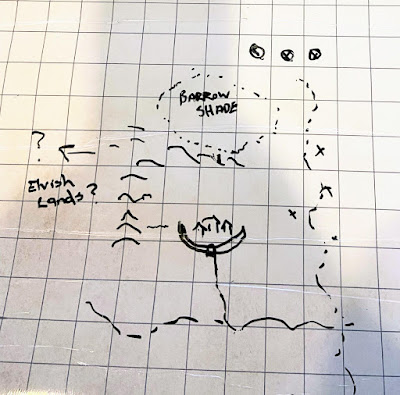
Early sketch of the campaign setting. A city, mysterious woods, strange lands

Furthermore, if players have read through or skimmed the Monster Manual there's a fair chance that most enemies will also seem familiar, and they'll start anticipating your moves and tactics. With a healthy disregard for "encounter balance" and "challenge ranks", find chances to throw your own custom encounters or variants at the adventurers.


And speaking of "encounter balance", it's no bad thing to consider how a party can be overwhelmed (or underwhelmed) as you develop your scenario, but true balanced encounters are a mirage. Provide strategic balance by allowing characters to withdraw if the opposition is too powerful, or press on with advantages they acquire though adventuring or the environment. Gives them battlegrounds where they can push a foe into a pit, control who runs across a narrow bridge, or chase down an assassin on a city-wall.

Move on from 5e

When you reach level 6 or thereabouts, consider moving on from 5e and its accelerating options and complexity. As GM, you'll face much more work for comparatively little increase in fun. Once you're familiar with the common language of D&D systems – classes, ability scores, hit points, armor class, saves – there are many alternative systems that retain the familiar D&D frameworks but also the excitement and simplicity of lower-level play.

  • White Hack: excellent flexibility and scope for player input. Can accommodate many professions and magic system/styles. Simple mechanical core; for example, combat damage only uses d6.
  • Beyond the Wall and Other Adventures: evokes traditional fantasy in the best way, and perfect for beginners and younger players. The core rules combine elements of older editions of D&D, including saving throws, with elements of 5e, but there's a solid, flexible game there. There are only three core classes, Warrior, Rogue, and Mage, but the free-form skill system and open list of spells mean it's easy to customize for professions. A ranger can be simply a warrior with tracking and outdoor survivals skills.
And finally, don't be afraid of "breaking" a finely balanced system with a few simple house-rules, especially if they ease the burden of managing combat and other intensive interactions. Rolling for initiative felt like fun the first few times, but it hampers a smooth transition to combat, and the more and varied the enemies, the more likely you are to lose track of turn order. I went to a tried and tested method of counting down by DEX score, and never noticed a problem.

Saturday, March 23, 2024

Root and Branch: generating your campaign

 When you start a campaign, solo or with a group, the best advice is always to start small. Unless you're following a published sequence, the most satisfying turn of play is to begin with one locality and watch the inciting incident grow into its own world.

But even starting small, it might be hard to come up with concrete details on the plain canvas, or it's tempting to try and visualize the campaign end game, and then back-engineer details to the very beginning.

This method gives you a starting point and leads, but is also open-ended, so the campaign grows as you unfold it. I've used it to launch solo campaigns and group campaigns, and it's always astonishing how soon you can find yourself in a fully-realized setting with a rich set of options, when all you started with was a punch-up in a tavern.


1. Set the entry point

Specify the point where your adventure begins. This could be the first step into the dungeon, or a mountain pass, or a rough tavern, or the starport, or something broader, like the western marches or a border city. The tone, theme, and style of the starting point are up to you: this is the world you want to enter, but you're only concerned with where to start, not what comes next.

2. Generate branching paths

This step takes inspiration from solo roleplaying. Using whatever semantic generators you have at hand – and why not Play ALL the Books – create 3–4 possible options. These are not whole scenarios, but possibilities, rumors, adventure hooks. Assign them to points just beyond the starting point.

For example, imagining a campaign of into the wilds treasure hunting, with a fantasy element, we started at the edge of the old empire and generated these random prompts:

  • Plain, village; closed, suspicious 
  • Rough, farm; urgent hunt (beast)
  • Hills, hamlet; innocents, omens
  • Plains, hall; ruins, wolves
Of course, if you need stronger narrative hooks, you can flesh out preliminary ideas so:

  • A crypt said to contain a weird black sword
  • A village threatened by wolves and bandits
  • An abandoned wizard's tower infested by goblins
  • Imperial spies are searching for an unusual schematic
  • A strange group of cultists, threatening residents of a peaceful hamlet

3. Follow a path

Now, either choosing yourself, randomly, or following your player’s decisions, begin to play out one of the potential scenarios, expanding on and developing the simple prompt with encounters and locations, as you would.

As you go, keep thinking how the other paths not yet taken might link to and reinforce the situation that emerges. Are those bandits lurking in the woods somehow connected to the goblins crawling over the ruined tower, and in that case, what are they really looking for? Who do they serve?

In the case of the first example, the randomly generated hamlet (innocents, omens) was under threat from a strange cult, following omens and clues linked to a prophecy and a lost ceremonial blade. It turned out that the place they would seek the blade next was the ruined hall where wolves were prowling, a day’s march across the plains.

4. Shadows and omens

By now, you probably start to see how the situation suggested new branches and possibilities. They can generate new options and points to move to, or begin generating connections between the existing points. Develop the next scenario that follows organically from the first. 

But to create something that is more than just action and reaction, you can begin sketching out the points and movements that hover just beyond the horizon of the current play. In Dungeon World, these looming possibilities are called “fronts”. In Against the Darkmaster, there are wonderful generators for establishing the identity of the “Darkmaster” the players will eventually confront. I think of these as threats or shadow states, that are established but not yet explicit, just at the horizon of the next branching path. 

In the example I started above, it turns out that a dark god of the old empire, a patron of greed and destructive consumption, was rising again in the near-forgotten ruins.

It might take a while to get there – that’s the campaign.


Friday, October 13, 2023

On Converting Your FRP Rules System

One of the intriguing sections of the old Iron Crown Enterprises modules for Middle-earth using MERP or Rolemaster (MERP/RM) was the section that sometimes appeared in the introduction: "Guidelines for Using Your FRP System with this Module: Conversion Notes". Not the snappiest title, but the table for converting between d100, d20, 3d6 stats, and even 2d6, contained the suggestion, even if impractical, that the mechanical bones of the module could in some way be translated and adapted between game system, providing a way into ICE's resources for Middle-earth without their cumbersome house system,

The best of ICE's modules were packed with detail and context, including excellent maps and locations, but they were often thin on actual scenarios. These materials were more like a campaign overview or a sandbox setting that assumed there would be a great deal of GM design and adaptation to draw out playable adventures from the details. If you could adapt to a simpler system, how much easier would it be to leverage to module content?

Of course, Basic Roleplaying, now in the new Universal Game Engine edition, would be an excellent solution and provide for extended campaign play. But what about a simple, universal, free-form system like XD20? Could this allow you to dive into the ICE Modules – and even capture the tone and style of MERP/RM – without the overhead of a point-by-point mapping to BRP.

Here's some tinkering with the idea.

Running ICE Middle-earth Modules with XD20 2ed


MERP Characters in XD20

XD20 characters have far fewer stats that MERP or Rolemaster, so the key is to approximate not to calculate equivalence.

For the key XD20 stats:
  • TAC: record as ST (Strength/Toughness) – this is the prime characteristic for a warrior or ranger
  • PSYCH: record as IT (Intelligence/Intuition/Initiative) – this is treated as the prime for scout/bard
  • WAH: record as PR (Presence/Resolve) – prime characteristic for mage/animist
Although the standard roll for STATS is d8 (1–8), I prefer to roll "first-level" stats on a d6 (1–6) so there's still a maximum stat to work towards (although stat raises are very, very rare in XD20).
Animist is an odd profession for Middle-earth, but conceptually is something more like a seer, loremaster, natural magician, or healer, than the cleric of a established religion, which are thin on the ground in Middle-earth.

Other characteristics

Hits (concussion hits): 10 base hits plus the lowest two of ST, IT, PR
It's a nice balancing factor that your hits in XD20 are circumscribed by your weakest stats. You might be strong, but too slow to dodge incoming strikes. (This is actually a little lower than Health in the XD20 book, but critical hits always counted more in MERP/RM.)

Level: corresponds loosely with MERP/RM levels, mainly as a way of estimating the challenge comparatively.
In XD20, levels don't confer much mechanical benefit but explicitly indicate greater skill, experience, and power.

Profession: use the MERP/RM professions in place of XD20 Character Type. Since there are no explicit skills in XD20, profession stands in for the skills and knowledge the character can most likely apply.

Background: Use the MERP/Middle-earth backgrounds to fill in the XD20 Story and Backstory.

Additional details

These are fun to add, especially if you want your character sheet to capture more of the feel of the old school systems with their abbreviations and numbers.

  • AT: Armor Type, not strictly necessary in XD20, but the RM system had a neat chart converting armor worn to a 1–20 value that could stand as a handy to-hit target number.
  • Melee OB: the close combat to-hit modifier (offensive bonus) – use ST
  • Ranged OB: the ranged combat bonus –  use IN
  • Spells OB: the "directed spells" bonus – use PR

Roll on

The old MERP/RM descriptive modifiers, from Routine to Light to Medium to Hard/V.Hard, and my favorites Sheer Folly and Absurd, would suggest a difficulty scale for XD20. But my aim is not to get the systems to scale each other, but to leverage the rich content of the classic modules for interesting gaming. If you roll it out, and it works, let us know in the comments.

Monday, January 17, 2022

Getting in to Adventure

The scenario is the bridge between the characters and the world. But how do your characters find themselves gathered at the Many Ways Inn?

Roll a die:
  1. Runaway: whether from a cruel or dull situation, you had to escape.
  2. Landless: through conflict or other chances, you have lost all your prospects and must, perforce, begin again.
  3. Summoned: whether by a letter from a patron or some other call, you are brought here to answer.
  4. Commanded: a patron or lord has ordered you to join some mission or venture.
  5. Happenstance: pure chance or a series of unfortunate events brings you to this juncture.
  6. Choice: Perhaps worst of all, you have chosen a life of danger and uncertainty.
What the character will do and encounter (the scenario) comes before mechanics (the game system). And although every scenario needs a setting, consider not just the “where” of the adventure but the “when…”. A scenario is not just a place, it’s a challenge, a dynamic, with constraints and possibilities, that the characters approach organically.

Here’s a simple starter.

Mutton and Marauders


Two ettins, Nygel and Treffor, have crept down from the Garshaws barrens to remedy their hunger, rounding up a small flock of sheep and a shepherd for good measure. Unknown to anyone, grimlock rustlers on a similar mission have picked up the ettins’ trail, and so rescuers, trolls, and grimlocks are set to intersect near a site* at the base of the Garshaws.

Nygel, Ettin [3] - Armed with tree-root club
Towering, massively strong, dull-witted, slow

Treffor, Ettin [3] - Armed with nocked axe, heavy hides act as crude armor
Lean, strong, sly, greedy

Grimlocks [1] a troop of 13 - Armed with spears, daggers, oddments of armor
Ragged, half-starved, nasty; dangerous when cornered, or when able to surrounded and sneak-attack an opponent

* Note that the adventure site is left open, with an eye to continuing the adventure. Is it a cave, leading into greater depths; or a stone circle near a partly exposed barrow-tomb; or a ruined hill-fort, a remnant of better times for the kingdom?

Resolution

The key to play-the-world or FKR resolution (the game system or rules) is not that every action is determined by referee fiat, but that the players concentrate on their characters and the situation, and the referee is ready, through judgement and experience, to resolve their efforts with tools that are both fair and simple to use.

It’s not that there are no mechanics, but that the mechanics are compact and easy enough to generate the chance element that means that the play is not simply dictated but develops in unexpected and dramatic ways as it runs.

Of course, the right tools that are also fair and simple require some judgement or a sense of what works at the table. This might well come from one’s experience of another game, but for anyone new to this style of play, it means that some guidelines, however slight, are useful.

So, here’s a brief rundown of the Tinkerage’s current resolution toolkit.

Roll and Read

Roll and read for characters assumes that characters have a fair, but by no means certain, chance of success, based on the conditions and their own aptitudes.
  • Roll 2d6 and read the outcomes, adjusting to circumstances: 2–3 (fail); 4–5 (mishap); 6–8 (standard - the expected outcome); 9–10 (good); 11–12 (great).
  • Can roll opposed and read for active opponents. Resilience rank breaks ties in opposed situations.
  • Modifiers of +1/-1 are very rare, for exceptional circumstances (magical gear, terrible conditions).
  • For a specific aim or outcome, like shooting a bow at a distant target, also read to meet a threshold number within the basic ranges: 6-8 is within standard range of difficulty; 9+ hard, and so on.
Combat is a kind of challenge where characters attempt to inflict strikes on their opponents while maintaining their own guard. A hit of sufficient force inflicts a strike, and when strikes are greater than a character’s resilience they are struck down. A character struck down may be stunned, injured, disarmed, or even killed or in a critical condition.

Screening rolls

For the referee, a single die is often the best tool. A screening roll is a quick roll of a die to clarify a situation or filter out a range of possibilities. 
  • Roll for quality or conditions: 1 is worst, 6 is best.
  • Roll for questions of probability: 2+ is very likely, 6+ is very unlikely.

Play the Adventure, not the Rules

Look back and think about Mutton and Marauders. The ettins are tough — unless the characters find a way to weaken them first, they should be harder to hit even for the strongest warrior in the group. Maybe roll and read and look for 9+ to hit? What if a character is hit by Nygel’s tree-root club? Make a screening roll to see how bad that strike is. The grimlocks aren’t strong individually, but what if they get the drop on the characters during the hunt, are they then defending at -1 or worse? What is the weather like when the characters set out to track the ettins — there’s another screening roll, perhaps.

And finally, if you don’t care for 2d6, then grab a d10 or put a classic d20 on the table. Think in terms of percentages? Then roll a d100. Know the rough chances of success and failure, give the characters a decent chance when they make a decent choice, and you have the core of freeform play at hand. Sooner or later the dice will surprise you and your players, and that’s when the adventure begins.

Friday, June 25, 2021

Solo: Play ALL the Books II

 In the first Play all the Books post, I tinkered with solo play and roll-and-read rules in the "play the world" style, mixing inspiration and rules from various rulebooks. In this post, I revisit these approaches with more detail about managing play when the GM, world-maker, and player are all the same soul.

The key to solo play in general is the the randomized oracle, which the solo player leans on to generate hints, plot points, and twists in general terms, since humans are generally brilliant at sketching these suggestions into scenarios. In this, I rely on Trevor Devall's dictum that you don't what to know what's doing to happen; what you need are suggestions that lead the game in directions you couldn't anticipate.

While there are plenty of great oracle systems out there (like Ironsworn, or the the classic Mythic GM Emulator), play all the books means exactly that: at the moment you're unsure or need inspiration you needn't refer to a custom solo rpg system; you look at your whole library, all the games, and select the random table or resolution system that answers to the needs of the moment.

For example, need a career or background? Grab the class and career tables from Warhammer Fantasy Roleplay. Not sure where to start and need a patron? Grab the patron encounter tables from Classic Traveller. By weaving between books, you not only keep inspiration fresh, you find a virtually a custom approach or tool for everything.

A campaign begins

To follow this in practice, several examples follow. And, of course, this style of play can work with multiple players as well.

Broadly speaking, we're interested in an open campaign, starting from the general idea of exploring and mapping a wild-region at the edge of the empire — perhaps a corner of the Harrowmarch?

So assuming a single fortified city as a base, I generated four random pieces of terrain from the Advanced Fighting Fantasy Allansia book, each with a theme from the various oracle tables in Ironsworn. Of the four potential destinations, I randomly selected the hamlet of Osfo (Hills, Hamlet, Innocent, Omens).

After investigating, the omen proved to be "Betrayal" — and the "betrayers" of the innocent village, while human, were revealed as acolytes and cultists of an ogre god of a long-vanished empire.

Looking for the next location, AFF provided a substantial castle, and so I speculated that the cultists were somehow connected to a yet more distant castle (ruled once by ogres?) and generated a handful of half-ruined towers and a keep using the dice-drop method from the Advanced Fighting Fantasy Second Edition rules. 

Running the scenario

Now, we come to point-to-point exploration. For each space, if occupied (likely, roll 3+ on a d6), I grabbed the dungeon encounter table from Out of the Pit, one of my favorite bestiaries:

  • In the gatehouse, a WIGHT (interesting, I used the FF interpretation of a wight, an undead servant—perhaps a cursed minion of the ogres?). With a lucky roll, our scout dodged this one.
  • In the first watchtower, a MANTICORE (I determined this beast has made its lair in the ruined tower, rather than being native to the castle). It took some climbing and sneaking to avoid.
  • In the attic over the inner gatehouse, four ZOMBIES (very curious!). There was a brief and dangerous fight. By chance, the zombies were guarding a substantial hoard or jewels.

At this point, I like to inject a twist or complication into the adventure, so having the Whitehack 3rd Ed. on hand, I rolled on the handy Modus table: "Shortage".  This lead to an interesting bit of GM-side decision making. Of course, shortage could be the simple twist that the adventurers run out of something (like arrows or rations), but that hardly alters the trajectory of the scenario. On the other hand, finding all those suspicious undead in the wrecked castle of the ogres suggested a darker possibility. Perhaps the ogres, once the terror of the region, were besieged and starved in their castle by the ancestors of the people of Osfo. First, the servants of the castle perished, or were sacrificed, to rise as undead servants. But later, the starving ogres themselves turned on each other in a horrible struggle, the strongest devouring the weakest...

So the final encounter was with a hideous ogre-GHOUL in the ruined keep. Curiously, the ghoul had no treasure (lost, perhaps, under the rubble) but I decided to roll for an item (Whitehack), a note, which from Ironsworn was about a "hidden weapon" — more than intriguing enough to launch a new adventure after a suitable rest.


Friday, September 20, 2019

The Cracked Kingdom

All was well in the reign of Curefin the Good, but that reign is over.

Martyn now sits on a contested throne, makes wars, grinds the poor, stirs rebellion.

They Fey Courts have grown dark and unfriendly, and meddle in mortal affairs.

Hedge-wizards and sorcerers bicker, and some finger the dusty covers of books of forbidden lore with a new interest.

And as old treaties fray, familiar enemies press at the borders of the cracked kingdom.
How often could a campaign, a game, get underway on the back of a few scribbled notes like these, found on a scrap of paper at the back of the desk?

Perhaps all you need to do with these is get ready to play the world:
  • Characters have 7 points for attributes and skills (max. +2); 6 Hits
  • In danger, roll 7+ to succeed: higher (9+) is better, lower (5-) is worse (negotiate modifiers)
  • In combat, everyone rolls and the higher roll succeeds: 1 light damage; 2 solid; 3 heavy (armour provides additional protection, scene by scene, on the same scale)

Thursday, April 14, 2016

The old, old world

It has been remarked that Arihmere, like the rest of the Harrowmarch, has a patchy and chaotic history, subject to the rise and fall of empires, and the whims of kings, raiders, and would-be conquerers. Sometimes, glimpses of an even older history can be caught, necessarily partial and sometimes contradictory, a patchwork of legends and surmise.

Elemental Age

Elementals, the titanic primal forces, carve the world out of the First Matter. Many of the more elaborate pantheons mark out their myths of origin at this time.

Serpent Age

The Eldest Serpents rule and squabble over a primitive world. Notable creatures of this era are massive and reptilian: wyrms, drakes, serpents, and so on.

Ourgarth Hunts

Honed to ferocity in the shadow of the greater wyrms, the Ourgarths (giants and trolls), worshippers of darkness and strength, march out to rule the world. They herd massive aurochs, stalked by dire wolves and long-toothed lions.

Fae Domains

The otherworldly and magical creatures collectively known as the fae overcome the ancient rule of the giants and carve out their own domains. The fae claim to have learned magic, amidst their endless quarreling, from the dreams of dragons, which merely shows how little they may be trusted on any matter.

Others say that spirits, severed from the Earth during the Elemental Age, creep back across the borders of the world with the help of the Fae.

Fae Wars

The normally feuding fae raise their war-banners against the Ourgarth, betraying an uneasy peace and beginning a long series of wars.

Circle Builders

Ancient human clans (now remembered only for their enigmatic stone circles) join the battle ranks of the fae in confronting the Ourgarth. Human claim to have learned magic from the fae, in return for the mastery of iron, but the fae assert that their arts were stolen.

Rise of Marass Grim

A Dark Lord of the fae betrays his lineage and joins with the giants. The simmering war turns into an epic confrontation.

Arak Amay

Loosely interpreted by all sides as "The Battle Lost by Winning". The Fae-Garth War ends in disaster. The fae shelter within their  fortified mounds and the deep forests, while the giants and trolls sulk in the Unterdaerk.

Elder Folk

The human survivors of all the above found kingdoms around the seas, river plains, and northern forests. They are later known as the Ellfolk.

What follows is loosely called history, from the austere and wolvish empires of Earduath and Kees, to the campaigns against the Reaver Thegns, to the various struggles of the Sundering Wars. Occasionally, a beast or monster out of one of the elder ages slithers into view, but only the dragons know the whole truth of what went before, and they are not inclined to share.

Wednesday, January 13, 2016

The Darkness in the North

The Withered Lands in the north-east are where Arihmere takes a dark turn, a region of wilderness and ruins held by the deadly and enigmatic Fell Lords, servants of a usurper who many believe was slain decades ago and revived by his scheming wife. These lands are the perfect setting for a gritty, or gothic, adventure, oriented towards exploration, treasure-hunting, and avoiding (or stumbling upon) old evils. The terrain would fit the open-ended possibilities of a "West Marches" style campaign or sequence of joined adventures. One could even imagine a campaign to reclaim a ruined manor and surrounding lands, in the style of "Darkest Dungeon".

Begin with an outpost:
  • A mere cross-roads, with a broken and enigmatic sign-post
  • A ruined manor-house, haboring grim secrets, and with a view of the cursed fens
  • An embattled city, the last to be recaptured may be the first to fall to the Fell Lords
  • An outpost around a ramshackle keep

Then there is the terrain. Start building and detailing the campaign map, situating both perils and rare treasures among the moors, fens, overgrown pathways, and tangled woods:
  • Tottering watchtowers, where sly grimelocks and lumbering grolls lurk. These monsters raid the borderlands and return to hide behind a multitude of crude traps.
  • Deep ravines (ideal for hiding treasure), infested by wyrms and naggs.
  • Spider-haunted woods, the perfect retreat for a half-mad witch.
  • Battlefields, haunted by sorrowful wraiths, where every unbroken blade has a name and a story.
  • And the decaying piles that once belonged to any one of the Fell Lords...

As the characters uncover and meet more, you might introduce one of the Fell Lords as an antagonist or hovering threat. These are powerful characters, corrupted by their service to an undead tyrant, living an unnaturally extended life and warped by their service. Their ultimate number and identities are a matter of speculation, as are their plans and true powers, but the unique nature of each of the Fell Lords subtly informs his or her domain:

  • The Necromancer: a sorcerer on the threshold of life and death, served by wraiths and shadows
  • The Sword: a fearsome warrior, and the tyrant's most hated enforcer, served by faceless armored warriors
  • The Intriguer: a spy and informer, served by crows and traitors
  • The Rider: the swiftest of the Fell Lords, served by spectral horses and their swift riders
  • The Artificer: the smith and craftsman, served by strange mechanisms and guarded by subtle traps
  • The Poisoner: a master of assassination and poisons, in his service are vipers and spiders of all kinds
  • The Hunter: a stalking terror, relentless in pursuit, served by wolves and other predators, mistress of the wild places
  • The Equivocator: the Fell Lords' spiritual advisor and preacher, master of guile and deception (you will never guess who your real enemy is)
  • The Prowler: a withered dwarf, the Fell Lords' tax-collector, greedy and clever, offering bribes with one hand and stealing with the other, and served by treasure hunters and ghouls

Ready to explore? Then grab some rules of your own or try the nameless d20 adventure game, and set to it.

Thursday, July 10, 2014

Beyond Arihmere

Although the old realm of Arihmere is unfortunate enough to contain more than its share of dangers, there are many notable realms beyond its borders.

South: The Sundering Wars

Cordaigne, once known as the Captured Kingdom, was held entire by the Theran Empire, but the empire is now divided, and both successor states, east and south,  claim a patchwork of provinces and cities within its borders. As though the separation were not chaotic enough, the brawling Andaran Princess and the nominal King of Arihmere intervene in the simmering conflict, siding with one side and the other, warring and aligning, claiming and ceding territory, every year.

North: The Fell Lords

A hundred years ago, or more (for historians argue the dates as much as they doubt the events) it is said that Haladrin the Good was the only king ever to unite Arihmere under the one banner. Naturally, he was murdered by an ambition noble, Streigil, the Lord of Vosse and Cabel. Streigil did not rule alone, for he had nine (or eleven, or twenty three) dark lords at his side to impose his terror, and a witch-wife besides. Naturally, there was a revolt, and Streigil was struck down in battle (some say, slain). But his lords would not accept defeat, and turned to sorcery and infernal pacts, and three years later the Lord of Vosse and Cabel (or his revenant) returned to the throne with his wife as Queen and First Minister.

Whatever the truth of it, the Lady Streigil was finally undone by blade and magic, and her Fell Lords retreated far into the north. Most likely they perished among the fens and mountains, but in the north they say that the Fell Lords still rule among the black forests and dead lands where the pastures wither, planning their return, when they will recover the master and his lady from the deep, secret barrow where they were interred.

The Copper Road

The Wolve's Lane is but the end of a long road, winding from the far, forgotten south-east, from mountains, steppes, deserts and rivers and boundless forest, from sprawling kingdoms, empires, satrapies, protectorates, khanates and republics. Through all of this runs The Copper Road, named for the earliest coins that travelled between its markets, before even steel was forged.

The Arrant Sea

The Arrant Sea is wild, cold and clear. Most ships follow the shore, but there are uncounted islands and strange landings out there. For three hundred years, the Reaver Thegns have come from over the horizon, raiding or seeking kingdoms to steal, and every once in a while, the great armoured backs of the Heviathands, bristling with walls and turrets, heave into view from the shore.


Wednesday, July 9, 2014

On the realm of Arihmere

Arihmere is a varied country, and its terrain includes wild coastlines, valleys and moors, and rugged mountains. There are many manors and villages, watch-towers and castles, and a handful of villainous cities and deep ports.

The peoples of Arihmere, townsman and peasant alike, have long settled within stout walls and hedges. Under the manorial system, most commoners are protected by the arms of a nobleman and his knights. But the realm is divided, tugged in many directions. In the south, the impetuous King Martyn spends the campaign season mired on the Sundering Wars, draining his treasury while he clings to the ancient title of king in the city of Warrensworth. At odds with him, but scattered along the north marches, the great houses bicker over precedence and territory, in the shadow of the Withered Lands.

In truth, Arihmere, like most of the Harrowmarch, has never been under a single law, but a subject of incomplete rule, from the ramshackle empires of the Erduath and Kees, to the clannish realms of the Ellfolk, to the Reaver Thegns and the witch-realms of the Leaden Lords before their fall. Much of what is known or said of the history of Arihmere is mere guesswork, were it not for the old pits and works of these lost domains.

The only certainty is that the realm is known for its haphazard and unlikely collection of perilous beasts and strange folks, for its grimelocks and trillits, ourgarths and teamsprits, monstrous wyrms and shy fae, and countless other oddities.

Tuesday, October 15, 2013

Arihmere

Arihmere, sometimes called the Wolves’ Lane, stands at the western end of The Copper Road. Falling into the Arrant Sea, with the Withered Lands of the Fell Lords to the north and the Sundering Wars simmering beyond the southern marches, it is a domain of wolf-haunted forests, wild moors, hedged manors, watchtowers and haunted tombs, ruled by grasping lords and sly wizards.

Arihmere is one of the more disreputable kingdoms of the Harrowmarch; nevertheless, its confused history of warring realms and tottering empires has left it with many respectably terrifying ruins and guarded treasures. The old heaps and pits are still inhabited by vile creatures, and only the most cunning and well prepared can meet them and survive.

About

Arihmere is a setting for fantasy gaming. It's suitable as a background, a suggestive sketch, or just a hazy collection of concepts. Future posts will begin to map it and fill in the blanks.

You can adapt it to your own fantasy adventure system, and also use it as the background for the Pick-up And Play rules on the tab above.