Showing posts with label GMing. Show all posts

Thursday, August 1, 2024

Reality check

Realism, in an RPG, is mostly a mirage. Even if the dice could do more than broadly approximate probabilities in the real-world, most players – and GMs – would not want to subject their characters, for example, to the actual risks of death and injury in a medieval battle.

Some groups aim for genre emulation – heroic fantasy, anime, pulp, horror, and so on – as a touchstone. But genre is a literary and narrative construct, and so it can lead you to try and meet the expectations of the story rather than find the story by playing the world.

In the fictional worlds of the games I play, I aim for _verisimilitude_, the appearance or sense of being real, which comes through consistent and believable details that emerge from real-world experience and expectations. Verisimilitude creates the impression that things are plausible without trying to accurately simulate the precise parameters and probabilities of any given event, like a sword-swing or a hike on an icy mountain path.

So in pursuit of verisilimilitude, it's a good thing to check your expectations against the real world. Over the years, I've gone into dungeons (like the catacombs of Paris), castles, towers, and recently the bunker forts of the Atlantic Wall, and each time I'm reminded of some useful, and grounding, facts that we can apply to our fantasy adventuring sites.

Passages, chambers

Passages in fortifications tend to be narrow – and cold. In your dunqeon designs, the corridor space is often less than 5 feet across, and ceilings are low. 

In game terms, there's often no room to swing a blade. Slashing sword attacks and similar strikes will be at a severe disadvantage. Dungeons favor thrusting weapons.

And in a chamber, the roof is rarely flat. It's likely a vault or an arch. Even so, there's often not a lot of headspace, and you're unlikely to be able to manage a down strike, or shoot an arrow or thrown spear very far without hitting the ceiling.

In game, missile attacks are limited to close range.

And stairs

Towers are great settings, but stairs, especially circular stairs tend to be extremely steep and narrow. Climbing is tiring, and the risk of putting a foot wrong on the narrow steps is considerable if you're under pressure: attacked or in a hurry. 

In game, climbing stairs under pressure should require a dexterity or fatigue check. And defenders have an advantage striking down. Consider also how missiles and objects thrown down stairs can create serious hazards!

Darkness and light sources

The actual underground is absolutely dark. Without light, players are effectively blind, and almost blind a very short distance from the entrance.

In actual pre-modern contexts, lights such as lanterns, candles, lamps, rushlights, and torches, only effectively illuminate a few paces in advance, or a small chamber. And if they're knocked out of your hand, they're likely to go out instrantly.

On the other hand, even a dim light is visible to observers from a long way away – effectively in line of sight.

This means that the most effective scout will move forward in the dark towards an unknown light source, rather like Bilbo Baggins sneaking up on the trolls' bonfire.

Used well, the effects of undeground darkness and low light can help create a tense, engaging situation for players, and keep them on edge as they explore unknown spaces. But many games, including current editions of D&D, forestall these options by making many character backgrounds adept at seeing in the dark, or with magical or other options for lighting available throughout the dungeon complex. If you like your encounters to effectively play out in well-lit arenas, so be it. But to add back some of the danger and uncertainty of low-light conditions, consider restricting those "night vision" abilities to situations where there is at least minimal incidental light, or applying other restrictions (for instance, low-light vision is greyscale only).

And while we're at it, lamp oil is not the basis for some kind of medieval Molotov cocktail. Fire, on the other hand, is potentially a great hazard in structures built with wood, with many wall-hangings and flammable materials.

Wednesday, June 12, 2024

That Year in the D&D20

So for about a year, the Tinkerage has been playing various editions, mainly the 5th, of the game with the ampersand in the title. This has been a surprise to everyone, since I've mostly steered clear of that system, having started in skill-based system like Traveller, and strongly preferring Basic Roleplaying and tinkering with various rules-light system options, such as Fighting Fantasy.

But there you go. When friends want a visiting GM – no DM – to help get started, why turn down a chance to try the system?


Here are some observations and non-binding recommendations.

5e is great for beginners

I didn't expect this, but for a first game session or three, 5e is great for beginners. New players with new characters feel capable, but with low hit points they're also vulnerable. Low-level threats are interesting, but usually go down after 1–2 hits, enough to pose a threat but not overwhelm. Players have a few custom options, but they're much more likely to be inventive and try fun strategies.


It's also interesting how many D&D rules seem designed to remove inconvenience or difficult choices. When I pointed out the finesse weapon rules, the dextrous halfling suddenly gained another level of damage with melee weapons.

Leveling up works, until it doesn't

Gaining levels is fun, and characters feel incrementally stronger and more capable, giving you scope to introduce more substantial threats – at least at low levels. But there are rocks ahead. Even within a few levels, there are more options, more special abilities, more feats to accommodate, and the complexity and number of considerations rises rapidly. Our campaign reached Level 4 – milestone leveling, not by experience points accountatncy – after just over a year of intermittent, mostly monthly play. I doubt the game is as easy to run after Level 6.

Rules? What rules?

For a year, I DM-ed mostly without a rulebook. I picked up the basics of how to run the game because I read the free, online Basic Rules, not to mention any one of the dozens of excellent retro-clones online.
D&D Beyond is a terrible app, but it's got most of what you need for 5e with the Basic Rules. The full online SRD has the rest. The players needed the Player Handbook, because they need all the trinkets and bolt-on abilities that come with leveling up (see above). If you have experience as a DM for any system, you can mostly create rulings to carry you through (Ability checks, screening rolls an a d6 or d20).


And there are many rules that you can dispense with or adjust. Too many characters can see in the dark. Short rests are extra HP on tap and encourage stilted adventuring (fight, rest – fight, rest). You can work without a lot of them.


Speaking of which, monster stat blocks are ridiculously long and detailed. I used a flat 1-2 line format (and you can find almost any D&D monster online with a simple search).


For instance:
GOBLINS
In+2*, Spd 30, HP 9, AC 15 Treated Hide, Spears +4 (1d6+2 pierce); light x-bow +4 (1d6+2 pierce)
*modifier to initiative roll


HOBGOBLINS
In +1, Spd 30, HP 15, AC 18 chain+shield; Longsword +5 (1d8+3)
+2d6 damage if striking in battle-line (martial advantage)

Use your own stuff

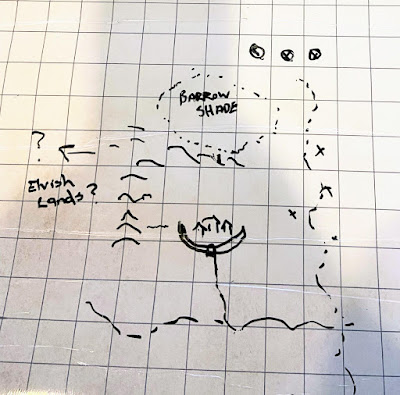
While there's nothing wrong with leaning on source books, the implied setting of the D&D rules is a veritable mishmash, a trope salad. Use your root and branch campaign ideas, and develop your own setting. Your player will appreciate a world to discover, not a tour.

Early sketch of the campaign setting. A city, mysterious woods, strange lands

Furthermore, if players have read through or skimmed the Monster Manual there's a fair chance that most enemies will also seem familiar, and they'll start anticipating your moves and tactics. With a healthy disregard for "encounter balance" and "challenge ranks", find chances to throw your own custom encounters or variants at the adventurers.


And speaking of "encounter balance", it's no bad thing to consider how a party can be overwhelmed (or underwhelmed) as you develop your scenario, but true balanced encounters are a mirage. Provide strategic balance by allowing characters to withdraw if the opposition is too powerful, or press on with advantages they acquire though adventuring or the environment. Gives them battlegrounds where they can push a foe into a pit, control who runs across a narrow bridge, or chase down an assassin on a city-wall.

Move on from 5e

When you reach level 6 or thereabouts, consider moving on from 5e and its accelerating options and complexity. As GM, you'll face much more work for comparatively little increase in fun. Once you're familiar with the common language of D&D systems – classes, ability scores, hit points, armor class, saves – there are many alternative systems that retain the familiar D&D frameworks but also the excitement and simplicity of lower-level play.

  • White Hack: excellent flexibility and scope for player input. Can accommodate many professions and magic system/styles. Simple mechanical core; for example, combat damage only uses d6.
  • Beyond the Wall and Other Adventures: evokes traditional fantasy in the best way, and perfect for beginners and younger players. The core rules combine elements of older editions of D&D, including saving throws, with elements of 5e, but there's a solid, flexible game there. There are only three core classes, Warrior, Rogue, and Mage, but the free-form skill system and open list of spells mean it's easy to customize for professions. A ranger can be simply a warrior with tracking and outdoor survivals skills.
And finally, don't be afraid of "breaking" a finely balanced system with a few simple house-rules, especially if they ease the burden of managing combat and other intensive interactions. Rolling for initiative felt like fun the first few times, but it hampers a smooth transition to combat, and the more and varied the enemies, the more likely you are to lose track of turn order. I went to a tried and tested method of counting down by DEX score, and never noticed a problem.

Saturday, March 23, 2024

Root and Branch: generating your campaign

 When you start a campaign, solo or with a group, the best advice is always to start small. Unless you're following a published sequence, the most satisfying turn of play is to begin with one locality and watch the inciting incident grow into its own world.

But even starting small, it might be hard to come up with concrete details on the plain canvas, or it's tempting to try and visualize the campaign end game, and then back-engineer details to the very beginning.

This method gives you a starting point and leads, but is also open-ended, so the campaign grows as you unfold it. I've used it to launch solo campaigns and group campaigns, and it's always astonishing how soon you can find yourself in a fully-realized setting with a rich set of options, when all you started with was a punch-up in a tavern.


1. Set the entry point

Specify the point where your adventure begins. This could be the first step into the dungeon, or a mountain pass, or a rough tavern, or the starport, or something broader, like the western marches or a border city. The tone, theme, and style of the starting point are up to you: this is the world you want to enter, but you're only concerned with where to start, not what comes next.

2. Generate branching paths

This step takes inspiration from solo roleplaying. Using whatever semantic generators you have at hand – and why not Play ALL the Books – create 3–4 possible options. These are not whole scenarios, but possibilities, rumors, adventure hooks. Assign them to points just beyond the starting point.

For example, imagining a campaign of into the wilds treasure hunting, with a fantasy element, we started at the edge of the old empire and generated these random prompts:

  • Plain, village; closed, suspicious 
  • Rough, farm; urgent hunt (beast)
  • Hills, hamlet; innocents, omens
  • Plains, hall; ruins, wolves
Of course, if you need stronger narrative hooks, you can flesh out preliminary ideas so:

  • A crypt said to contain a weird black sword
  • A village threatened by wolves and bandits
  • An abandoned wizard's tower infested by goblins
  • Imperial spies are searching for an unusual schematic
  • A strange group of cultists, threatening residents of a peaceful hamlet

3. Follow a path

Now, either choosing yourself, randomly, or following your player’s decisions, begin to play out one of the potential scenarios, expanding on and developing the simple prompt with encounters and locations, as you would.

As you go, keep thinking how the other paths not yet taken might link to and reinforce the situation that emerges. Are those bandits lurking in the woods somehow connected to the goblins crawling over the ruined tower, and in that case, what are they really looking for? Who do they serve?

In the case of the first example, the randomly generated hamlet (innocents, omens) was under threat from a strange cult, following omens and clues linked to a prophecy and a lost ceremonial blade. It turned out that the place they would seek the blade next was the ruined hall where wolves were prowling, a day’s march across the plains.

4. Shadows and omens

By now, you probably start to see how the situation suggested new branches and possibilities. They can generate new options and points to move to, or begin generating connections between the existing points. Develop the next scenario that follows organically from the first. 

But to create something that is more than just action and reaction, you can begin sketching out the points and movements that hover just beyond the horizon of the current play. In Dungeon World, these looming possibilities are called “fronts”. In Against the Darkmaster, there are wonderful generators for establishing the identity of the “Darkmaster” the players will eventually confront. I think of these as threats or shadow states, that are established but not yet explicit, just at the horizon of the next branching path. 

In the example I started above, it turns out that a dark god of the old empire, a patron of greed and destructive consumption, was rising again in the near-forgotten ruins.

It might take a while to get there – that’s the campaign.


Saturday, April 15, 2023

Rise of the meta-GM

If you find yourself flicking through one RPG system, like Imperium Maledictum, and thinking to yourself that it could be played with XD20 or Basic Roleplaying (BRP), then you might be a meta-GM.

Meta-gaming, from the player's point of view, is when a player uses their personal, real-life knowledge of the game rules or setting to guide their in-game character's actions. Sometimes this is useful, or at least tolerable, and sometimes this can disrupt or short-circuit a scenario. 

Meta-gamesmastering, the domain of the meta-GM, by extension, is when the GM or referee uses their personal, real-life knowledge of the patterns of RPG mechanics and game design to guide their in-game practice, improvising, interpreting, anticipating, or modifying the procedures of the game system in use at the table.

The phrase came to me because I'm in the situation of GMing for friends and players new to gaming and perforce using their preferred system—Dungeons & Dragons 5e. D&D has its faults, but for new players it's a smooth and engaging introduction to fantasy RPGs. All the same, D&D's exception-based structure and parade of feats and special cases has the tinkerer looking at how others adapt the core rules, which led me to the Dungeon Craft channel and this hugely informative take on the core mechanics of the D20 system: You Don't Need Apps to Play D&D

This really means that you don't need the D&D app, loaded with sourcebooks and rules links (or even, in fact, the rule book) to make a determination at the table about success or failure, especially within a statistically "balanced" system. The Professor DM has often referenced XD20 and, in particular, the insight that there are only 20 numbers on a d20—so however complex the decision tree around chances of success or failure, the end product is only ever a roll of a d20 with 20 possible outcomes, and for any given roll a few points either side of the target are rarely significant. 

Which, in meta-gaming terms, leads us to a table like this (with apologies to Dungeon Craft):

Roll a D20 —Did the character succeed?
20 — Yes! A 20 always succeeds and the roll is taken as a critical success
15+ —Yes — a high roll succeeds
10+ —Yes, perhaps. The character usually succeeds, if proceeding with skill OR an advantage (situational bonus, weaker enemy)
6+ — Maybe, but only with skill AND situational advantage, otherwise, mostly no; the GM decides.
2+ — No (there's always a change of failure from 1-5)
1 — Fail! The worst possible roll is always a failure or a fumble

You might notice, as a meta-GM, that this table itself only has six rows, which, with a glance at And Play, can be further abstracted thus:

Roll a D6 —Did the character succeed?

6 — Yes! A 6 always succeeds and this is often the best possible result
5+ —Yes — a high roll succeeds (unless the task is desperate or foolhardy)
4+ —Yes, probably. The character usually succeeds, all things being equal, unless the task is notably difficult or the character is challenged or unprepared)
3+ — Maybe, but only with skill OR situational advantage; the GM decides
2+ — No, unless the task is easy and the character is fully prepared; the GM decides
1 — Fail! The worst possible roll is always a failure or a fumble (always a chance of failure)

So, if the GM (or DM) is playing as a referee, mediating between the rules and the players but working within the general structure of the system, which includes adapting the given procedures for situations that aren't specifically anticipated, such as calling for an ability check when no specific rule applies, then the meta-GM is applying their knowledge of the rules and the general processes and trends to emulate the experience without strict reference or fidelity to the rulebook.

This might be the trick to FKR style play: you're still running a game, not proceeding by GM fiat, but the meta-GM has tools that generate the same experience with fewer intervening processes.

This isn't necessarily the best or easiest way to play. With a balanced, grounded system like BRP and engaged players, running encounters within the frame of the published rules can make for great sessions. Adjust the meta/in-system balance to your taste (and keep the d6 handy).

But, as I suggested earlier, if you wanted to pick up the concept of a game but not the overhead of the system itself, then the path of the meta-GM beckons. The premise of Imperium Maledictum, playing the agents of a powerful yet flawed patron against the grim background of intrigue and violence of the Warhammer 40K setting, is intriguing. Perhaps it would also work well as a gritty medieval fantasy, restaged in the mazy courts and alleyways of a city on the borderlands? Can the meta-GM then run everything with a handful of gothic-looking d6s?

A d20 and a d6 on a table

In X-Treme Dungeon Mastery 2E, the Hickmans liken their XD20 system to the custom car engine that the GM has to attach to the transmission to turn the wheels of the game. That’s the meta-GM role: assembling the engine and welding it to the chassis to make the custom vehicle for their game, their adventures. The particular parts you choose—d6, d20, d100—classes, skills, abilities, counters, and stage-dressing, are all up to you.


Monday, January 17, 2022

Getting in to Adventure

The scenario is the bridge between the characters and the world. But how do your characters find themselves gathered at the Many Ways Inn?

Roll a die:
  1. Runaway: whether from a cruel or dull situation, you had to escape.
  2. Landless: through conflict or other chances, you have lost all your prospects and must, perforce, begin again.
  3. Summoned: whether by a letter from a patron or some other call, you are brought here to answer.
  4. Commanded: a patron or lord has ordered you to join some mission or venture.
  5. Happenstance: pure chance or a series of unfortunate events brings you to this juncture.
  6. Choice: Perhaps worst of all, you have chosen a life of danger and uncertainty.
What the character will do and encounter (the scenario) comes before mechanics (the game system). And although every scenario needs a setting, consider not just the “where” of the adventure but the “when…”. A scenario is not just a place, it’s a challenge, a dynamic, with constraints and possibilities, that the characters approach organically.

Here’s a simple starter.

Mutton and Marauders


Two ettins, Nygel and Treffor, have crept down from the Garshaws barrens to remedy their hunger, rounding up a small flock of sheep and a shepherd for good measure. Unknown to anyone, grimlock rustlers on a similar mission have picked up the ettins’ trail, and so rescuers, trolls, and grimlocks are set to intersect near a site* at the base of the Garshaws.

Nygel, Ettin [3] - Armed with tree-root club
Towering, massively strong, dull-witted, slow

Treffor, Ettin [3] - Armed with nocked axe, heavy hides act as crude armor
Lean, strong, sly, greedy

Grimlocks [1] a troop of 13 - Armed with spears, daggers, oddments of armor
Ragged, half-starved, nasty; dangerous when cornered, or when able to surrounded and sneak-attack an opponent

* Note that the adventure site is left open, with an eye to continuing the adventure. Is it a cave, leading into greater depths; or a stone circle near a partly exposed barrow-tomb; or a ruined hill-fort, a remnant of better times for the kingdom?

Resolution

The key to play-the-world or FKR resolution (the game system or rules) is not that every action is determined by referee fiat, but that the players concentrate on their characters and the situation, and the referee is ready, through judgement and experience, to resolve their efforts with tools that are both fair and simple to use.

It’s not that there are no mechanics, but that the mechanics are compact and easy enough to generate the chance element that means that the play is not simply dictated but develops in unexpected and dramatic ways as it runs.

Of course, the right tools that are also fair and simple require some judgement or a sense of what works at the table. This might well come from one’s experience of another game, but for anyone new to this style of play, it means that some guidelines, however slight, are useful.

So, here’s a brief rundown of the Tinkerage’s current resolution toolkit.

Roll and Read

Roll and read for characters assumes that characters have a fair, but by no means certain, chance of success, based on the conditions and their own aptitudes.
  • Roll 2d6 and read the outcomes, adjusting to circumstances: 2–3 (fail); 4–5 (mishap); 6–8 (standard - the expected outcome); 9–10 (good); 11–12 (great).
  • Can roll opposed and read for active opponents. Resilience rank breaks ties in opposed situations.
  • Modifiers of +1/-1 are very rare, for exceptional circumstances (magical gear, terrible conditions).
  • For a specific aim or outcome, like shooting a bow at a distant target, also read to meet a threshold number within the basic ranges: 6-8 is within standard range of difficulty; 9+ hard, and so on.
Combat is a kind of challenge where characters attempt to inflict strikes on their opponents while maintaining their own guard. A hit of sufficient force inflicts a strike, and when strikes are greater than a character’s resilience they are struck down. A character struck down may be stunned, injured, disarmed, or even killed or in a critical condition.

Screening rolls

For the referee, a single die is often the best tool. A screening roll is a quick roll of a die to clarify a situation or filter out a range of possibilities. 
  • Roll for quality or conditions: 1 is worst, 6 is best.
  • Roll for questions of probability: 2+ is very likely, 6+ is very unlikely.

Play the Adventure, not the Rules

Look back and think about Mutton and Marauders. The ettins are tough — unless the characters find a way to weaken them first, they should be harder to hit even for the strongest warrior in the group. Maybe roll and read and look for 9+ to hit? What if a character is hit by Nygel’s tree-root club? Make a screening roll to see how bad that strike is. The grimlocks aren’t strong individually, but what if they get the drop on the characters during the hunt, are they then defending at -1 or worse? What is the weather like when the characters set out to track the ettins — there’s another screening roll, perhaps.

And finally, if you don’t care for 2d6, then grab a d10 or put a classic d20 on the table. Think in terms of percentages? Then roll a d100. Know the rough chances of success and failure, give the characters a decent chance when they make a decent choice, and you have the core of freeform play at hand. Sooner or later the dice will surprise you and your players, and that’s when the adventure begins.

Friday, October 16, 2020

Fighting Fantasy for your freeform game

Fighting Fantasy (the minimal gamebook rules) could be enough of a framework for rule-light, freeform gaming, with a little judgement and tweaking.

Core Rules

Choose your character type, such as WARRIOR, SORCERER, or ROGUE.
Your initial SKILL is 7.
Your initial STAMINA is 1d6+6
Your initial LUCK is 1d6+6

Choose three Special Skills to complete your character, and note any equipment your GM allocates (usually a weapon, a backpack, some coin and rations, and optional potions).

Now, since most of the FF rules are easy to remember, you can start playing.

Test for Skill when character abilities and Special Skills are on the line.
Test for Luck when chance and happenstance are the deciding factor.
Roll probability (x in 6) when the chance of success depends on a variety of factors, including the external circumstances and the soundness of the player's plan.

In combat, the highest roll plus SKILL hits, and the standard wound is 2 STAMINA. Bigger creatures can ATTACK more than one target per round, but never roll more than once.

Apply modifiers freely as the conditions and tactics on the battlefield change.

Playing FF as a Freeform Game

From then on, the GM is free to work like the author of an adventure gamebook to develop and extend the rules according to the direction the game takes.

Experience

At certain key points in the campaign, characters advance 1 SKILL and 2 STAMINA. Advances in LUCK are rare and memorable.

At first, SKILL 7 characters will be able to defeat only weaker creatures (goblins, orcs, rat men, wolves); choose their foes carefully, and encourage "inventive" tactics. Common Trolls have SKILL 8. In this world, many stronger creatures become deadly terrors, dreadful, lurking threats to be avoided or outwitted, at least until the adventurers gain a few SKILL points.

Humans have a maximum of 12/24 in SKILL, LUCK, and STAMINA. Dragons are always terrifying.

Combat

STAMINA damage is weariness as well as wounds and shock. Player characters are truly injured at zero STAMINA.

Most weapons begin at 2 damage, but over time the characters may discover finer weapons, or come across armour with a x in 6 chance of stopping a point or two of damage.

Arrows (test of Skill to hit) become an important strategy to wear down a foe before closing for battle.

Magic

Add a MAGIC score (or another custom score, like RESOLVE, if your campaign requires it). Design a list of spells, set the cost in MAGIC, and continue. Perhaps learning spells leaves little time for sword-play (-2 SKILL in battle).

Friday, February 21, 2020

He do the NPCs in different voices

If you're interesting in the craft of the GM as much as solo gaming and its possibilities, then it's well worth your time to check out Trevor Devall's Me, Myself, and Die! channel on YouTube.

In his own words, "Voice actor Trevor Devall plays tabletop RPGs solo-style, fulfilling the roles of both player and GM." And while the Tinkerage has plenty to get on with other than watching other people play, Devall conducts his solo sessions with such tremendous verve and skill, as well as drama and humor, that they make for entertaining viewing for their own sake.

Devall, as it happens, is a talented voice actor, and not everyone will master the accents and tones he uses to build character, but it's worth noting how Devall makes every NPC unique with an accent, a description, a particular attitude or affliction that is simple and memorable.

The same goes for scene description. In his GM role, Devall doesn't layer in unnecessary or additional detail, but skillfully focuses on and repeats the key details that make the location distinct.

The last GM trick to borrow is what I as a writer would call "blocking". Me, Myself, and Die! is often very funny, but Devall alternates humor and drama, even pathos and moments of contemplation. Some sessions and games aim for a particular tone, be it comedic or grim-dark. Good GM-ing reminds us that varying the tone always hightens the contrasts and makes the action more memorable.

I'm not sold on Savage Worlds as a system, and prefer to Play All the Books for solo-inspiration, but Me, Myself, and Die! is a great illustration of what effective GMing can mean for any game session, and I look forward to the next series.