Tuesday, June 7, 2016

Roll and Read advanced version

This post picks up on the system for Roll and Read solo play, with a different die and extended for group RPG play. It's also based on a micro-system submitted for the 200 Word RPG Challenge.

Roll and Read

The key to Roll and Read is that, however you set up the character, the player and the GM agree on the expected outcome of the action before the die is rolled. If the die comes up high, then things go better for the character; if the roll is low, things are worse.

In this case, a warrior is expected to hit a foe, a wizard is expected to cast a spell, a scout is expected to pass unseen through cover. If the task is harder for some reason, then only partial success can be expected, and the character needs a lucky or even exceptional roll to do well. On the other hand, if the task is easy, then only an awful roll will have an effect on the outcome, although an unlucky roll may cause complications. There are no modifiers, ever, because the circumstances are already built in to the range of expectations.

The system also heads off the effect of pure dumb luck. A novice won't necessarily fell a master because of a lucky critical; a master won't necessarily foul up utterly because the die rolls low.

The advanced system uses a d10, because the range of results can be split into five categories, and centers on the expected outcome.

When you meet danger (skirmishes, traps, natural hazards), discuss the expected outcome, take action, and then roll a 10-sided die. The GM will determine the consequences accordingly.
1-2: Awful/Poor
3-4: Unlucky/Weak
5-6: Expected/Middling
7-8: Lucky/Strong
9-10: Advantageous/Exceptional
As before, if the character seems to hold a great advantage in terms of skill or circumstance, then roll two dice and take the best.

And, if the roll seems like sheer bad luck or runs against expectations for the character, then the player may spend a point of Res to reroll (representing the character's effort and resolve). If this roll is Exceptional (9-10), then the Res point is not lost.

Characters in Roll and Read

Characters can be generated free-form, with a short list of skills, abilities, knacks, and characteristics. 

They have one common score, Resources/Resilience (Res), a measure of resourcefulness, resolve, level, luck, and even hit points. If you want to take an experience levels approach, then character can begin with Res [1] and gain Res as they adventure. If you want characters to have a better chance of survival from the start, begin at Res [3]. Res should be used to represent character ability by gaining rerolls on critical efforts.

Combat

Combat is a matter of rolling, comparing, and reading a result. Hence, a squad of attacking gremlins might pose a slight threat for an armed warrior. In combat against these gremlins, if you’re Unlucky, you’re hit. This character would stand on equal or slightly better terms with a ragged goblin, and so probably wound with an Expected/Middling roll, and a Strong roll would read as a vital hit. But even an armed and armoured knight would have to be make an Exceptional roll to hurt a powerful dragon.

Where the roll is low enough that the character is wounded, deduct a point of Res. When the last point of Res is lost, the character is out of play for the rest of the scene. The player can then decide whether the character continues on play or is discarded.

[This section updated 11/23/16]

Encounters and Hazards

For the sake of comparison, encounters, and hazards, can be ranked on the Poor to Exceptional scale. Encounters can also have individual or group Res.

Thursday, April 14, 2016

The old, old world

It has been remarked that Arihmere, like the rest of the Harrowmarch, has a patchy and chaotic history, subject to the rise and fall of empires, and the whims of kings, raiders, and would-be conquerers. Sometimes, glimpses of an even older history can be caught, necessarily partial and sometimes contradictory, a patchwork of legends and surmise.

Elemental Age

Elementals, the titanic primal forces, carve the world out of the First Matter. Many of the more elaborate pantheons mark out their myths of origin at this time.

Serpent Age

The Eldest Serpents rule and squabble over a primitive world. Notable creatures of this era are massive and reptilian: wyrms, drakes, serpents, and so on.

Ourgarth Hunts

Honed to ferocity in the shadow of the greater wyrms, the Ourgarths (giants and trolls), worshippers of darkness and strength, march out to rule the world. They herd massive aurochs, stalked by dire wolves and long-toothed lions.

Fae Domains

The otherworldly and magical creatures collectively known as the fae overcome the ancient rule of the giants and carve out their own domains. The fae claim to have learned magic, amidst their endless quarreling, from the dreams of dragons, which merely shows how little they may be trusted on any matter.

Others say that spirits, severed from the Earth during the Elemental Age, creep back across the borders of the world with the help of the Fae.

Fae Wars

The normally feuding fae raise their war-banners against the Ourgarth, betraying an uneasy peace and beginning a long series of wars.

Circle Builders

Ancient human clans (now remembered only for their enigmatic stone circles) join the battle ranks of the fae in confronting the Ourgarth. Human claim to have learned magic from the fae, in return for the mastery of iron, but the fae assert that their arts were stolen.

Rise of Marass Grim

A Dark Lord of the fae betrays his lineage and joins with the giants. The simmering war turns into an epic confrontation.

Arak Amay

Loosely interpreted by all sides as "The Battle Lost by Winning". The Fae-Garth War ends in disaster. The fae shelter within their  fortified mounds and the deep forests, while the giants and trolls sulk in the Unterdaerk.

Elder Folk

The human survivors of all the above found kingdoms around the seas, river plains, and northern forests. They are later known as the Ellfolk.

What follows is loosely called history, from the austere and wolvish empires of Earduath and Kees, to the campaigns against the Reaver Thegns, to the various struggles of the Sundering Wars. Occasionally, a beast or monster out of one of the elder ages slithers into view, but only the dragons know the whole truth of what went before, and they are not inclined to share.

Friday, March 25, 2016

On Magic World

Chaosium has now reclaimed the rights to RuneQuest and Glorantha, and we're given to understand that these combined will become their banner fantasy RPG product, while a new BRP Essentials becomes the root system for a loose constellation of BRP inspired games. This leaves the Basic Roleplaying book (BRP) as a sort of attic collection of rules, and Magic World, previously the core rulebook for the nascent BRP fantasy line, is left out in the cold.

We have plenty of time for RuneQuest as a rules set, but Glorantha is not our fantasy lozenge floating on an infinite sea. Its massive timeline, overlapping pantheons, entangled myths, and cultural melange are fascinating but too hard to buy in to, like a club whose rules are too obscure to encourage joining, especially when we're looking for a world of our own to create (which is probably a slipstream version of Middle-Earth and the world of Firetop Mountain, illustrated by Russ Nicholson). Consequently, it might be time to take a closer look at Magic World before it slips out of view.

In many ways, Magic World exhibits the strengths and weaknesses of the recent BRP era at Chaosium. Its rules are a compilation of some of the best of the BRP percentile, skill-based system: smooth and easy to pick up, especially if you're familiar with any other iteration. Character generation in particular is probably one of the easiest tasks in the BRP family: roll Characteristics, calculate secondary scores (HP, MP, damage bonus, skill category modifiers) and then add set percentiles (60% at most) to a specified number of skills. Combat, once you decode the wonky presentation, is also quick and intuitive (there are no location hit points to slow you down, and only one kind of special or critical). Overall, it's a highly playable system and probably an excellent place to get into your own version of Middle-Earth or Allansia.

On the other hand, the rules are clearly recycled from earlier systems: the Chaosium Stormbringer RPG in particular and RuneQuest III. This leaves us reading some eerily familiar passages, and tumbling over rules that don't apply, such as references to fatigue in the bestiary. Of course, there are errata, but the point is that the errata are too long. And the wider point is that the presentation suffers from this copy-and-paste approach. The BRP combat sequence, for example, has a fair few steps but they all flow fairly cleanly: declare intent, set initiative, roll, compare attack and parry/dodge, assign results. But the "Combat" chapter is unnecessarily long, and the effect is somewhat scattershot. Skimming headings, you see "Actions in a Round", then "Resolving Combat", then "Order of Actions", then "Actions", then "Resolution" and yet the next section resumes "Hand-to-Hand Combat" with "Game Procedures" – how many times are we told about actions and resolution? Compare this to the tight presentation in the BRP Quickstart, and you realize that the whole chapter should have been thoroughly adapted and revised, especially for new players.

The reused artwork, a mishmash of styles and settings, similarly does not always capture the intended feel of the game, and although the sorcery magic system is serviceable, since it's based on the spells from Stormbringer, which were themselves added on to a system mainly designed around summoning and binding Moorcockian demons, the spell selection is not particularly inspiring. To play a sorcerer, your choices revolve mainly around spells that enhance or diminish effects (such as damage, armor, or characteristics) or a number of nasty offensive magics, reflecting the chaos influence of Stormbringer magic. That's not especially a problem if you want a low-magic campaign (there are no fireballs or lightning bolts here) or to grab your spell ideas from other sources, but the book is called Magic World after all, but offers only a few interesting or engaging spells.

The sample setting, the Southern Reaches, is more like Roman Britain than medieval Europe, a former frontier where first supernatural powers ruled before retreating, and where an empire has now replaced the roaming tribes of humans and orcs. It's effectively a colonial province, and designed with plenty of built-in conflict, with the return of the shadowy, shape-shifting fay and tensions between the two ruling houses presenting the most potential for adventure. The Southern Reaches are therefore an excellent sample setting, but they sit only lightly on top of the main rules. The rules for Allegiance between Light, Shadow, and Balance, for instance, would work nicely in heroic fantasy but it's not clear how they apply in the Southern Reaches, or to the fay. It might have been better to explore how the Magic World rules could be used to run a variety of different fantasy settings with varying themes and tones, as per the excellent guidelines in the "Settings" chapter of the BRP rulebook.

Given time and more design and editing, Magic World could have been an excellent product, but it now sits uncomfortably between being the "Fantasy BRP" and a minor game due to be eclipsed by RuneQuest and Glorantha. Depending on the quality and design of the new BRP Essentials, it could remain a fine go-to game for fantasy adventure, but its chance to capture the high ground among fantasy RPGs has passed. Not a fumble by any means, but a hit, parried.


Thursday, February 18, 2016

A quick conversion - XD20 and Sword & Backpack

Not too long ago, the Tinkerage mentioned the ultra-light Sword & Backpack system. The rules of Sword & Backpack are minimal: roll a d20 and decide what's fair. But with a little tinkering, Sword & Backpack could be adapted to XD20, or my still nameless D20 adventure rules.

Here's how it goes. In Sword & Backpack you can play as either a Warrior, Rogue, or Sorcerer. These are types rather than classes, but we can all guess that the Warrior excels in combat, the Rogue in subterfuge and skill, and the Sorcerer in magic. Hence, we can map these to XD20 stats, or Fighting, Skill, and Magic.

Warrior (WAR) = TAC/Fighting
Rogue (ROG) = PSYCH/Skill
Sorcerer (SOR) = WAH/Magic

Assign the three scores (WAR, ROG, SOR), takes the best score as the character's primary role, figure out hits and what-not (possibly a simple three-strikes-and-you're-out system), and you're ready to play. Each character type will be able to do a little of what other types can: a sorcerer can engage in light swordplay, a rogue can read a magic scroll.

Once you have your characters, why not try the scenarios in the Lanternport adventure setting, because, really, nothing can beat delving into a vast, magical library guarded by traps and bookwyrms, and patrolled by eerie undead librarians.

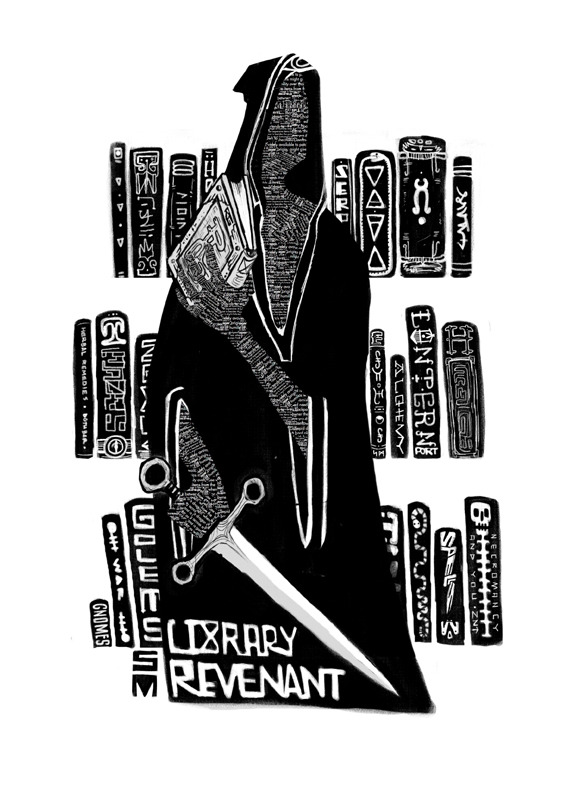
Art by Sam Mameli
Library Revenant - Art by Sam Mameli


Sunday, February 7, 2016

A handful of skills for FF

One of the nice things about basic Fighting Fantasy is that most of what an adventurer would want to do is described in the section on common adventuring situations. There's no need for a comprehensive system of skills (as opposed to SKILL) as these situations describe what most adventurers will actually want to do in the confines of adventure: search, sneak, bribe or persuade monster, snaffle loose objects, break doors and chests.

There a plenty of skill-based systems (like BRP) with extensive lists of skills, but a few common skills could be a good way to add variety to your Fighting Fantasy character without adding much more to the rules.

Adventuring Skills

Stealth: The first thing you want to try is sneaking past that guard.
Tricks & Traps: Finding the location of that hidden latch, tampering with a trap, opening a stubborn lock, detaching a tempting purse.
Persuasion: A bluff, a clever lie, or a call to a higher purpose, even striking a good bargain, all require persuasiveness.
Bind Wounds: Any form of rough healing, or first aid after battle.
Strength: Not simply training and endurance, but knowing the point of leverage, or where to exert pressure when you break open a chest or smash down a door.
Hunting & Tracking: There's always game to pursue and tracks to follow in the wild.
Wayfaring: It's useful to know the hidden paths, the landmarks, the places of safety and concealment.
Learning: Reading is one thing, but this character knows how to decipher an ancient script, the name of that demon, that crucial fragment of old lore. Speak, friend, and enter!

How to use the skills

Skills are not just training, they're habits, strategies, approaches. In a simple FF game, offer characters three skills when they're created. Then, if the conditions are right, the skill confers a +1 or +2 bonus to action. This can be added to SKILL (or WITS, if you use that option), or even a probability roll.

Wednesday, January 13, 2016

The Darkness in the North

The Withered Lands in the north-east are where Arihmere takes a dark turn, a region of wilderness and ruins held by the deadly and enigmatic Fell Lords, servants of a usurper who many believe was slain decades ago and revived by his scheming wife. These lands are the perfect setting for a gritty, or gothic, adventure, oriented towards exploration, treasure-hunting, and avoiding (or stumbling upon) old evils. The terrain would fit the open-ended possibilities of a "West Marches" style campaign or sequence of joined adventures. One could even imagine a campaign to reclaim a ruined manor and surrounding lands, in the style of "Darkest Dungeon".

Begin with an outpost:
  • A mere cross-roads, with a broken and enigmatic sign-post
  • A ruined manor-house, haboring grim secrets, and with a view of the cursed fens
  • An embattled city, the last to be recaptured may be the first to fall to the Fell Lords
  • An outpost around a ramshackle keep

Then there is the terrain. Start building and detailing the campaign map, situating both perils and rare treasures among the moors, fens, overgrown pathways, and tangled woods:
  • Tottering watchtowers, where sly grimelocks and lumbering grolls lurk. These monsters raid the borderlands and return to hide behind a multitude of crude traps.
  • Deep ravines (ideal for hiding treasure), infested by wyrms and naggs.
  • Spider-haunted woods, the perfect retreat for a half-mad witch.
  • Battlefields, haunted by sorrowful wraiths, where every unbroken blade has a name and a story.
  • And the decaying piles that once belonged to any one of the Fell Lords...

As the characters uncover and meet more, you might introduce one of the Fell Lords as an antagonist or hovering threat. These are powerful characters, corrupted by their service to an undead tyrant, living an unnaturally extended life and warped by their service. Their ultimate number and identities are a matter of speculation, as are their plans and true powers, but the unique nature of each of the Fell Lords subtly informs his or her domain:

  • The Necromancer: a sorcerer on the threshold of life and death, served by wraiths and shadows
  • The Sword: a fearsome warrior, and the tyrant's most hated enforcer, served by faceless armored warriors
  • The Intriguer: a spy and informer, served by crows and traitors
  • The Rider: the swiftest of the Fell Lords, served by spectral horses and their swift riders
  • The Artificer: the smith and craftsman, served by strange mechanisms and guarded by subtle traps
  • The Poisoner: a master of assassination and poisons, in his service are vipers and spiders of all kinds
  • The Hunter: a stalking terror, relentless in pursuit, served by wolves and other predators, mistress of the wild places
  • The Equivocator: the Fell Lords' spiritual advisor and preacher, master of guile and deception (you will never guess who your real enemy is)
  • The Prowler: a withered dwarf, the Fell Lords' tax-collector, greedy and clever, offering bribes with one hand and stealing with the other, and served by treasure hunters and ghouls

Ready to explore? Then grab some rules of your own or try the nameless d20 adventure game, and set to it.

Friday, November 13, 2015

What are the BRP Essentials?

The Tinkerage has great respect for Chaosium's Basic Roleplaying, or BRP, a system that feels rules light even though it's packaged in a rules-and-options heavy compendium known as the BGB, or "Big Golden Book".

Now Chaosium has announced that BRP will become BRP Essentials, the core 32-page rulebook for a BRP family of games. But what are the essentials of a BRP system? Are they BRP itself, Runequest, in its current or past incarnations, or even one of the OGL offshoots, such as Mongoose Runequest (MRQ), Legend, or OpenQuest?

Here's a purely speculative take:

Characteristics: STR, CON, SIZ, DEX, INT, POW, CHA (or APP)... EDU perhaps? They go back a long time, the roughly 1–20 scale connects us to the early RPGs. SIZ modifies HP, but do we ever roll against it? Could they sit directly on a percentile scale and still work? I like characteristics to modify skill scores. I like a characteristic roll when no skill applies.

Skills: Percentile skills are the core of BRP. Move them around, rename them. The only thing that puzzles me is why Resilience is a skill in certain versions: you can train to get tougher and fitter, that's how CON and STR go up, but how can you learn to be tougher, especially as you age?
Adding up skills and skill category modifiers is the longest part of character creation, so can this be easier? The MRQ system of base skills defined by adding characteristics is tempting, and cuts out skill category modifiers.

Rolls and resolution: BRP uses a 5% critical and a 20% special. Other version derived from MRQ use a 10% critical. This is a big difference. Which is more essential? Well, players love to roll specials, and specials that happen about 20% of the time when they succeed feel about right. But 10% is easy to calculate.

Combat, Initiative, Hit Locations: Action points, Strike ranks, DEX ranks, combat actions. Options make combat more tactical, but draw out the encounter. Over time, I'm found that most excitement in combat comes from setting, strategy, and fast resolution. I favor the simple system of DEX-based initiative. And no hit locations. They slow down the action, impose odd results, and make designing and running encounters a chore for the GM.
Are there good reasons for different critical types by weapon (slash, bash, impale)? Surely, but in practice we usually just roll double the damage dice and move on.

Experience: The elegant system of rolling against a skill once it has been used for steady, incremental gains through experience is surely one of the essentials of BRP.